

Park · London · ⭐ 9.5/10 · 49434 reviews · updated: 2026-08-04 08:22:17
Address: London, United Kingdom
Regent’s Park — a city plan that became a park
Almost four hundred acres of lake, rose garden, sports field and ringed terrace, laid out as a single architectural idea by John Nash for the Prince Regent from 1811. It is the only Royal Park that was designed all at once, as a piece of town planning rather than as a former hunting ground gradually opened up, and the cream stucco terraces that frame it are as much a part of the design as the trees. Inside the ring there is London’s largest rose garden, the world’s oldest scientific zoo, a heronry, an open-air theatre that has run every summer since 1932, and the largest area of outdoor sports pitches in central London. North of the canal, Primrose Hill rises to 64 metres and delivers the protected panorama that every film about London eventually uses.
Highlights
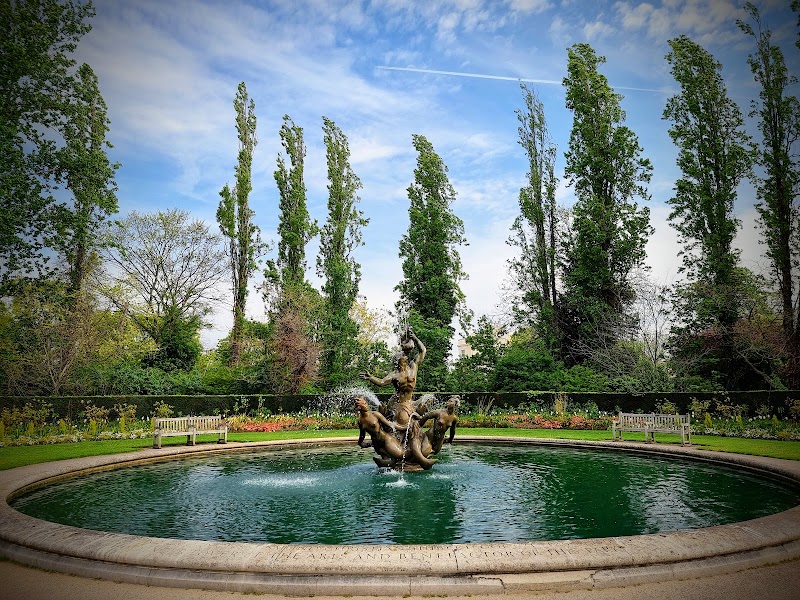
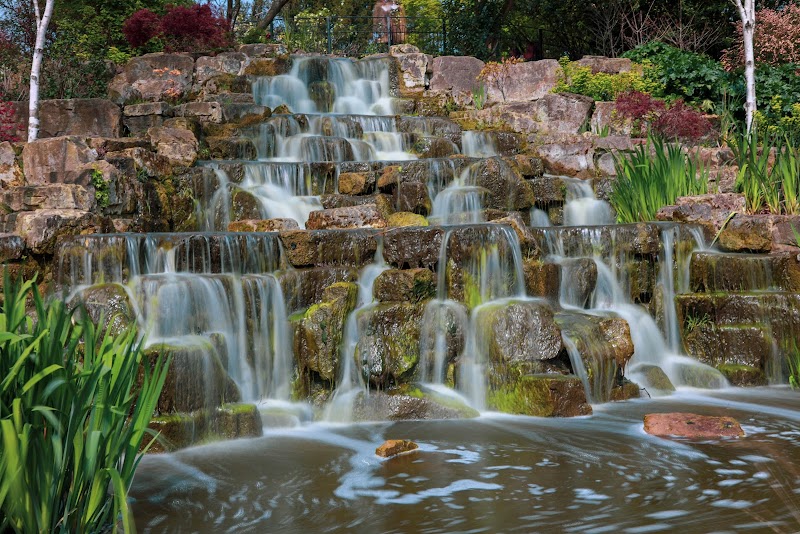
- Queen Mary’s Gardens — laid out inside the Inner Circle and opened in 1932, named for the wife of George V. It holds around 12,000 roses in some 85 varieties, making it London’s largest rose garden, together with a celebrated delphinium border, a begonia garden and a Japanese-style island garden with a waterfall. The main flush comes in June and the scent carries across the whole enclosure.
- Nash’s terraces — the ring of neoclassical palace-fronts built between 1821 and 1827: Cornwall Terrace first, then Hanover Terrace, Sussex Place with its curious pointed turrets, Chester Terrace with one of the longest unbroken façades in London, and Cumberland Terrace, the grandest of them all, designed as the view from the palace Nash intended to build for the Prince Regent and never did.
- London Zoo — the Zoological Society of London was founded in 1826 by Sir Stamford Raffles, and the zoo opened in the park’s northern corner in 1828 as the world’s first scientific zoo, admitting the public in 1847. Decimus Burton designed the original layout; later came the Mappin Terraces of 1913–14 and Berthold Lubetkin’s spiral Penguin Pool of 1934, a landmark of modernist architecture.
- The Open Air Theatre — founded in 1932 in a natural hollow within Queen Mary’s Gardens and running every summer since. It seats over a thousand, plays Shakespeare, musicals and new work between May and September, and performs whatever the weather does.
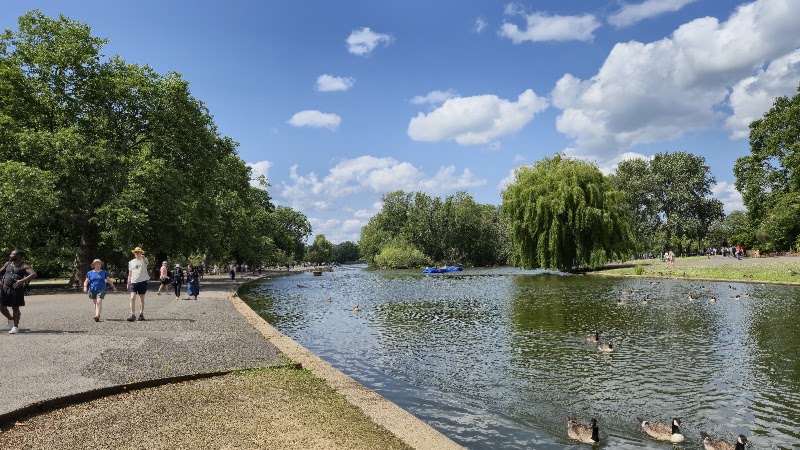
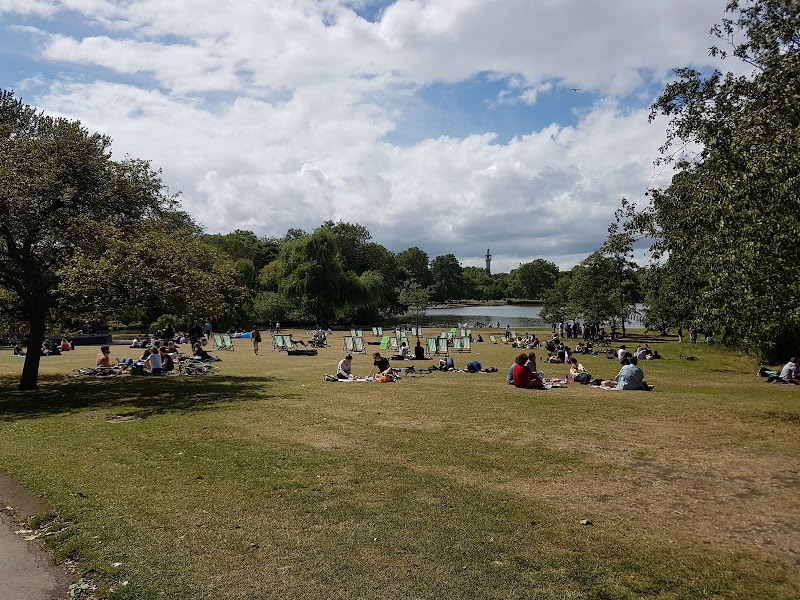
- The boating lake and its herons — a large ornamental lake with rowing boats and pedalos and a long-established grey heron colony breeding on the islands, along with waterfowl in unusual numbers. There is a separate children’s boating pond.
- Primrose Hill — just north across the Regent’s Canal, a summit at 64 metres with an inscribed viewing stone carrying a line by William Blake, and one of the few legally protected sightlines in London: the whole central skyline laid out from the Post Office Tower to the City and the Shard.
What you’ll find
Nash’s plan divided the park with two ring roads — the Outer Circle, about 4.45 kilometres round, and the Inner Circle, about one kilometre — and almost everything of interest is arranged in relation to them.
- The Avenue Gardens and the Broad Walk — formal Italianate parterres with fountains, urns and ribbon bedding, designed by William Andrews Nesfield in 1863–64 and restored to his drawings in the 1990s. The Broad Walk runs the length of the park’s eastern side as its principal promenade.
- St John’s Lodge Garden — a small, secluded formal garden laid out in 1889 behind one of Nash’s original villas, “fit for meditation” by design, and open to the public though most visitors never find it.
- The Hub and the sports fields — an underground sports pavilion designed by David Morley Architects and opened in 2005, serving the largest concentration of outdoor pitches in central London: cricket, football, rugby, hockey, softball, netball, Australian rules and athletics.
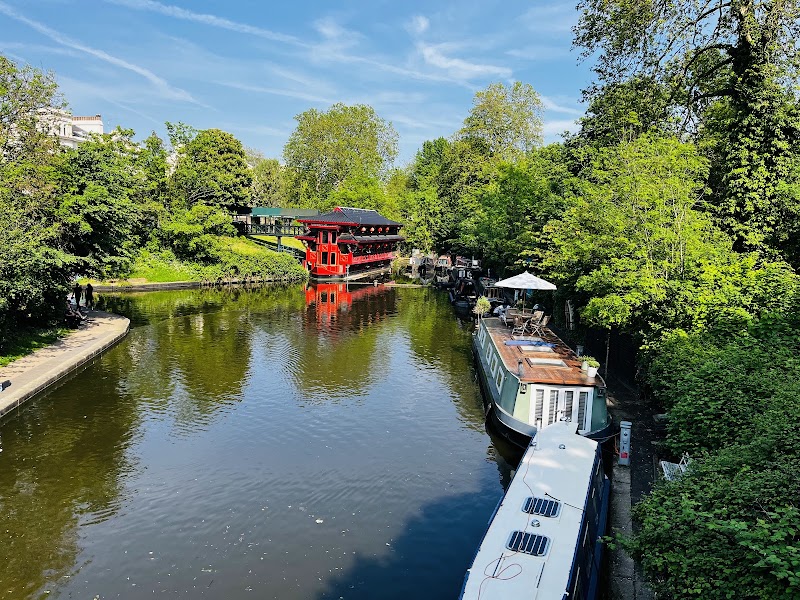
- The Regent’s Canal — cut in 1820 as part of the same Nash scheme and engineered by James Morgan, it runs across the northern edge past the zoo, linking Paddington to the East End; waterbus services work the stretch between Little Venice and Camden.
- Institutions inside the ring — Regent’s University London occupies the Inner Circle on the site of Bedford College, Britain’s first higher-education college for women; Winfield House, built in 1936 and the residence of the United States Ambassador since 1955, has the second-largest private garden in London; and the golden dome of the London Central Mosque, completed in 1977 to Sir Frederick Gibberd’s design, rises above the western trees.
- Everyday facilities — several cafés and a lakeside restaurant, three playgrounds, tennis courts, a bandstand, an allotment garden, waymarked running routes and a full circuit of the Outer Circle that has become one of the most heavily used cycling loops in Britain.
Things to do — and who it’s for
- Rose and garden enthusiasts — Queen Mary’s Gardens in June is the single best horticultural set piece in central London, and the Avenue Gardens give a rare, accurately restored example of high-Victorian formal bedding.
- Families with children of any age — the zoo, three playgrounds, boats on the lake, a children’s boating pond and enough flat grass to lose an afternoon in.
- Runners and cyclists — the Outer Circle is a continuous 4.45-kilometre loop with gentle gradients, used by club cyclists at dawn and by runners all day; add Primrose Hill for the only real climb in the area.
- Theatre and culture visitors — the Open Air Theatre’s summer season, and in October the park hosts a major international art fair that fills the southern half with temporary pavilions.
- Architecture and history walkers — a circuit of the Outer Circle is effectively a tour of Regency London, and the terraces are best read from the park side, which is how Nash intended them to be seen.
- Anyone chasing the view — Primrose Hill at sunset, particularly on 5 November when the whole panorama fills with fireworks, is one of the fixed rituals of London life.
Getting there & practical
The park straddles Westminster and Camden in north-west inner London, with Marylebone to the south, St John’s Wood to the west and Camden Town to the east. Regent’s Park station on the Bakerloo line is closest to the southern gates and the Avenue Gardens. Baker Street, served by the Bakerloo, Circle, Hammersmith & City, Jubilee and Metropolitan lines, is the most useful all-round entrance and the shortest walk to Queen Mary’s Gardens. Great Portland Street on the Circle, Hammersmith & City and Metropolitan lines covers the south-east, and Warren Street on the Northern and Victoria lines is a little further out. For the zoo end use Camden Town on the Northern line or St John’s Wood on the Jubilee line; for Primrose Hill, Chalk Farm on the Northern line is nearest. Marylebone and Camden Road stations take national rail services, and a canal waterbus runs between Little Venice and Camden through the zoo. Entry to the park and all its gardens is free, including Queen Mary’s Gardens and St John’s Lodge Garden. You pay separately for the zoo, the Open Air Theatre, boat hire, tennis and pitch bookings. Pedestrian gates open at 5am and close at dusk, and the closing hour moves every month — around half past four in midwinter, as late as half past nine at midsummer — while vehicle gates keep longer hours. Allow two hours for the gardens and the lake, half a day if you add Primrose Hill, and a full day with the zoo.
When to visit
Spring starts with bulbs along the Broad Walk and the blossom around the Inner Circle, and by late April the Avenue Gardens are planted out. June is the peak: the roses in Queen Mary’s Gardens reach full flush, the delphinium border is at its height, the Open Air Theatre season is running and the evenings are long enough to do the park after work. July and August stay busy and warm, with the sports pitches in constant use and the lake at its best for boats. Autumn is the quiet reward — the plane trees and limes along the Broad Walk turn, the light on the stucco terraces goes gold in the late afternoon, and in October the international art fair brings a very different crowd for a few days. Winter strips the park back to its structure, which is when Nash’s plan reads most clearly: the terraces are fully visible through bare branches, the herons start nesting as early as January and February, and the panorama from Primrose Hill is at its sharpest on a cold clear evening. There are no deer here, so the rutting-season cautions that apply in Richmond and Bushy Park do not arise; the practical winter warning is simply the early closing time, which can catch people out in November and December.
Good to know
The land came to the Crown under Henry VIII with the dissolution of the monasteries and was kept as a hunting ground called Marylebone Park; from the mid-seventeenth century it was let out as farmland and smallholdings. When those leases fell in in 1811 the Prince Regent, the future George IV, saw the chance for something ambitious, and John Nash produced a scheme of extraordinary scope: a landscaped park ringed by grand terraces, filled with fifty-six villas and crowned by a summer palace for the Prince, connected to Westminster by a new processional road. Most of it was cut back. The palace was never built and only eight villas went up, but the terraces were, between 1821 and 1827, and they remain one of the most complete pieces of Regency town planning in Europe. Nash’s canal, engineered by James Morgan, opened in 1820. The park was closed to the public at first; it opened in 1835, initially for only two days a week, and access widened over the following years. The Zoological Society of London, founded in 1826 by Sir Stamford Raffles, opened its collection in 1828 for scientific study, and admitted the general public in 1847. The lake was the site of one of the worst accidents in the park’s history: on 15 January 1867 the ice gave way under a crowd of skaters and about forty people drowned, after which the lake was deliberately made shallow. William Andrews Nesfield designed the Avenue Gardens in 1863–64. Queen Mary’s Gardens followed in 1932, on ground inside the Inner Circle that the Royal Botanic Society had leased since 1840, and the Open Air Theatre opened in the same year. The park has its darker anniversaries too: on 20 July 1982 an IRA bomb exploded beneath the bandstand during a concert by the Royal Green Jackets, killing seven bandsmen — the same morning as the Hyde Park attack. In 2005 the underground sports pavilion known as the Hub was opened by Queen Elizabeth II, consolidating the park’s role as central London’s principal sports ground. Primrose Hill, bought for public use in 1841 and never built on, keeps a statutory protected view of the capital’s skyline.
Visitor tips
- Queen Mary’s Gardens is inside the Inner Circle and easy to walk past without realising it is there. Go in through the gates in the ring that encloses it and follow the noise of the fountains; the rose beds are behind the outer planting.
- The closing time changes every month and is genuinely early in November, December and January. If you are walking to Primrose Hill for sunset in winter, plan the route out of the park before you go up the hill.
- St John’s Lodge Garden is open to the public but has no signage worth speaking of. It sits behind one of the original villas near the Inner Circle, and it is usually empty even on a busy summer Sunday.
Questions & answers
Is the park free? Yes, and so are all its gardens, including Queen Mary’s Gardens, the Avenue Gardens and St John’s Lodge Garden. London Zoo, the Open Air Theatre, boat hire, tennis courts and pitch bookings are all charged separately.
What are the opening hours? Pedestrian gates open at 5am. Closing is at dusk and shifts month by month, from around half past four in December and January to about half past nine in June and July, with vehicle gates open longer. Check the current month’s time before an evening visit.
When are the roses at their best? June, without much argument. Queen Mary’s Gardens holds roughly 12,000 roses in around 85 varieties and the main flush is in the first half of the month, with a second, lighter showing later in the summer. Go in the morning; the scent is strongest before the heat.
Is London Zoo inside the park? Yes, occupying the northern corner beside the canal, and it is a separate ticketed attraction with its own entrance and hours. It is the oldest scientific zoo in the world, opened in 1828, and its Penguin Pool of 1934 and Mappin Terraces are listed buildings in their own right.
How is Primrose Hill related to the park? It is managed as part of the same Royal Park but lies just north across the Regent’s Canal, so it is a separate walk of a few minutes. The summit is 64 metres high, the climb is short and steep, and the view south over central London is legally protected from being built out.
Can you cycle in Regent’s Park? Yes. The Outer Circle is a continuous 4.45-kilometre road loop and one of the busiest training circuits in the country, particularly at dawn. Cycling is restricted on the internal footpaths and in the gardens, so use the designated routes.
What can you see for free besides the gardens? The terraces from the park side, the lake and its heronry, the Avenue Gardens, the bandstand, the Broad Walk, the wildlife along the canal and the whole of Primrose Hill. Only the zoo and the theatre are behind a ticket.
How long should I allow? An hour to walk the Broad Walk and the lake. Two to three hours to include Queen Mary’s Gardens and a circuit of the Inner Circle. Half a day with Primrose Hill and the canal, and a full day if the zoo is on the list.
Photos
Show 1 more photos
Visitor reviews
Reviews last updated: 2026-08-04 08:22:17
Data is refreshed monthly. Sources: londoname.com and editorial picks based on reviews.
A perfect place to enjoy nature. It's April, and the roses are already blooming.
A great park. Lots of animals, few people, quiet and peaceful.
A pleasant and clean park. Within the grounds there are farm animals in an enclosure.
A big, green park; there are pitches for football and cricket, and boat hire (£28 for a family). A zoo is nearby.
A rest for adults and children alike. A variety of animals, interesting. Everything is well thought out, there are places to relax and plenty of cafés.