

Park · London · ⭐ 9.5/10 · 23476 reviews · updated: 2026-08-04 08:22:20
Address: Battersea Park Rd, London SW11 4NJ, United Kingdom
Battersea Park — Victorian reform, wartime memory and a Buddhist pagoda on the Thames
Two hundred acres of riverside on the south bank, built on marshland deliberately raised with dock spoil, this was one of the great social experiments of Victorian London: a park created to civilise a notorious stretch of ground where duels were fought and Sunday fairs got out of hand. What grew there is unusually layered — Britain’s first public sub-tropical garden, a boating lake with a Victorian pump house, sculpture by Henry Moore and Barbara Hepworth, a golden Buddhist pagoda facing the water, and the field where football’s modern rules were first tried out.
Highlights
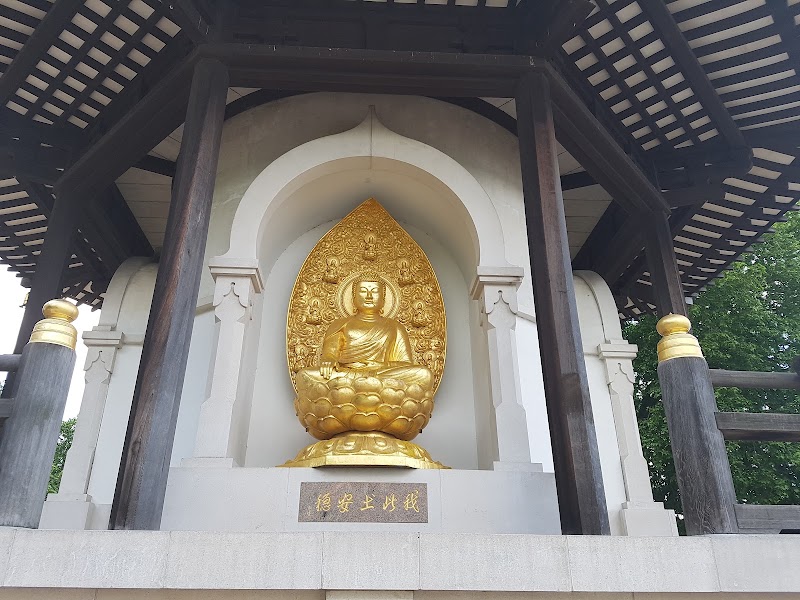
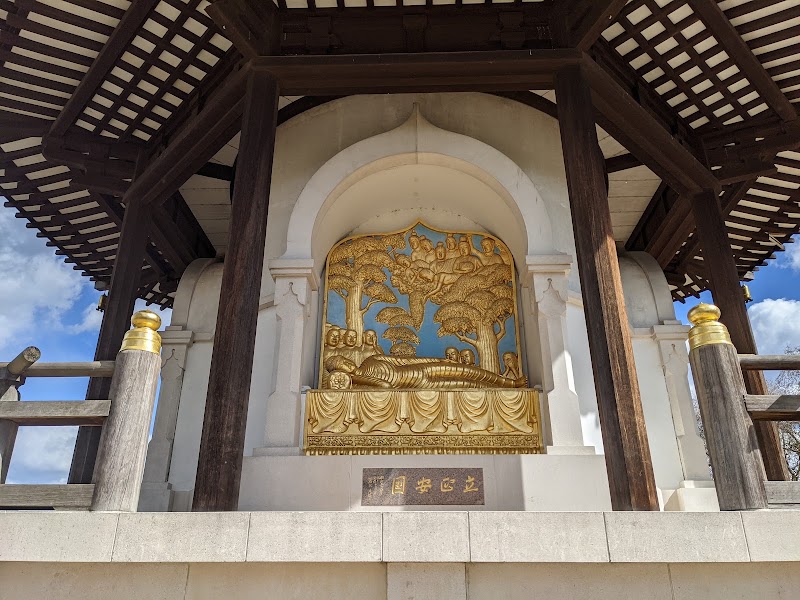
- The London Peace Pagoda — completed in 1985 by monks, nuns and volunteers of the Nipponzan-Myōhōji order, carrying four gilded bronze Buddhas facing the four directions and depicting birth, enlightenment, first teaching and death; a resident monk has tended it ever since.
- The Sub-Tropical Garden — laid out in 1863 by the park’s first superintendent John Gibson, a plant hunter who had collected orchids in India for the Duke of Devonshire; it was the first public garden of its kind in Britain and launched a national fashion for exotics and carpet bedding.
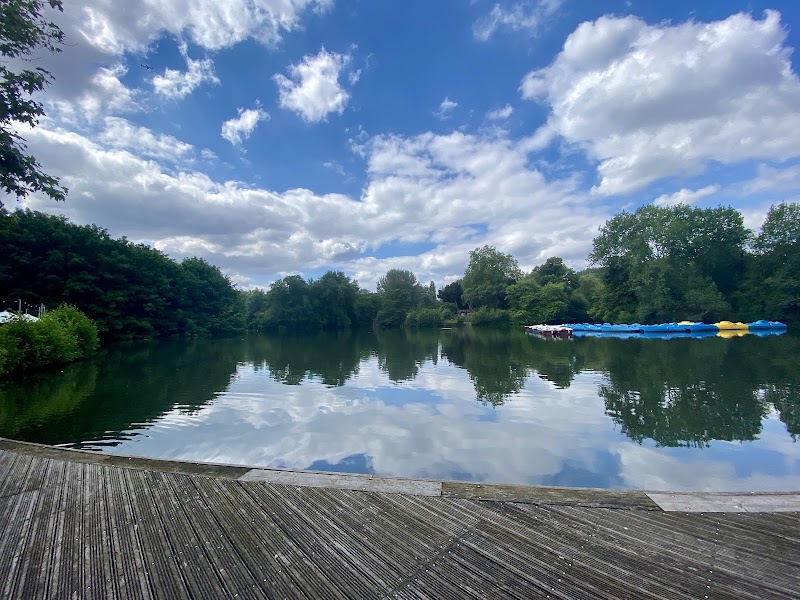
- The boating lake and Pump House Gallery — the fifteen-acre lake is fed by a Grade II listed pumping tower built in 1861 by the engineers James and William Simpson, now a free contemporary art gallery.
- The Old English Garden — a walled cottage-style garden of 1912 with a pergola, seating arbours, a central pool and deep herbaceous borders, rebuilt in 1989 after years of neglect.
- Sculpture in the open air — Henry Moore’s Three Standing Figures, carved in the late 1940s, and Barbara Hepworth’s Single Form beside the lake, the small version of the memorial to Dag Hammarskjöld that stands at the United Nations in New York.
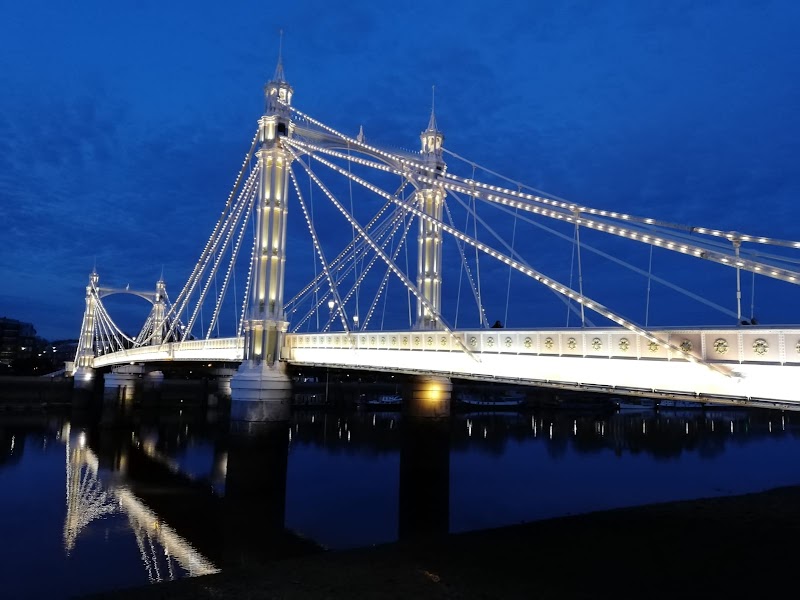
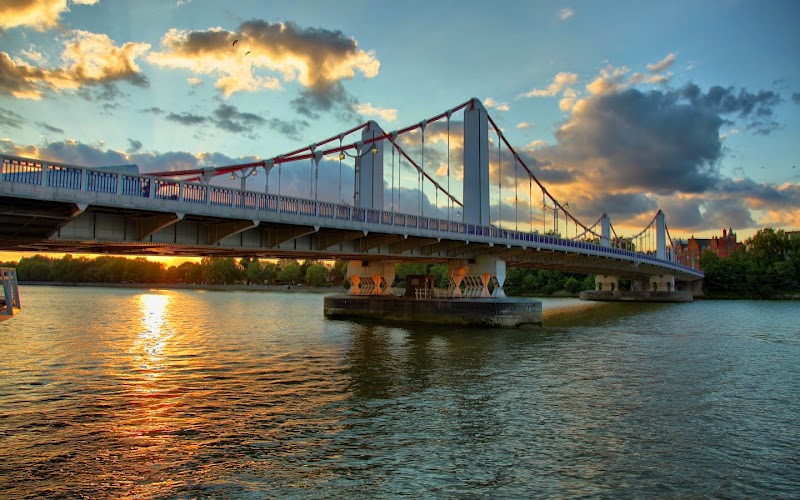
- The riverside promenade — a long walk along the Thames between Chelsea Bridge and Albert Bridge, with one of the best free views of the Chelsea waterfront in London.
What you’ll find
The park is a Victorian pleasure ground that never stopped adding to itself, which is why it manages to be both a serious horticultural site and a sports complex. Formal gardens sit within a matter of minutes of running tracks, and the lake divides the ornamental western half from the more active east.
- Gardens: the Sub-Tropical Garden, the Old English Garden, the Winter Garden, the Rosery and the herb beds, plus a long woodland walk through mature trees.
- Water: the boating lake with its cascades and islands, rowing boats and pedalos in season, and heron, cormorant and grebe on the water all year.
- Sport: the Millennium Arena athletics track, all-weather pitches, tennis courts, bowls, a trim trail, and cycle hire including recumbent and adapted machines.
- For children: two large playgrounds, a paddling area in summer, a small ticketed children’s zoo and a high-ropes course in the trees.
- Art and culture: the Pump House Gallery, the restored bandstand, and the surviving scatter of mid-century sculpture from the open-air exhibitions.
- Cafés near the lake and the main gates, public toilets, and three pay-and-display car parks inside the gates.
Things to do — and who it’s for
- Families with young children — the combination of playgrounds, boats, the zoo and flat traffic-free paths makes this one of the most practical whole-day parks in inner London.
- Runners and cyclists — the perimeter carriage drive gives a measured traffic-calmed loop, and the athletics track is open to the public outside club bookings.
- Gardeners and plant enthusiasts — the Sub-Tropical Garden is a living piece of horticultural history, and the Old English Garden peaks with the herbaceous borders in June and July.
- Art lovers — free changing exhibitions in the Pump House Gallery, plus permanent Moore and Hepworth work outdoors that most visitors walk past without realising what it is.
- Anyone seeking calm — the Peace Pagoda terrace facing the Thames is one of the genuinely contemplative spots in the city, and drumming and ceremonies mark Buddhist observances there through the year.
- Photographers — the pagoda against a low winter sun, the lake at first light, and the Chelsea skyline from the promenade at dusk are the three reliable shots.
Getting there & practical
The park lies in the London Borough of Wandsworth on the south bank of the Thames, directly opposite Chelsea and immediately west of the Battersea Power Station development. Battersea Park station, served by Southern, and Queenstown Road (Battersea), served by South Western Railway, are both a short walk from the eastern gates; Battersea Power Station on the Northern line is a similar distance, and the river bus pier there gives an approach by water. On the north bank, Sloane Square, Victoria and Pimlico are all within walking distance across the bridges. Buses 44, 137, 156, 344 and 452 serve the perimeter. Entry to the park is free, as is the Pump House Gallery; the children’s zoo, boat hire, the high-ropes course and the crazy golf are separately ticketed concessions. Gates are generally open from around half past six in the morning until half past ten at night, with the ornamental gardens locked earlier. Two hours suits a focused visit; families routinely spend the whole day.
When to visit
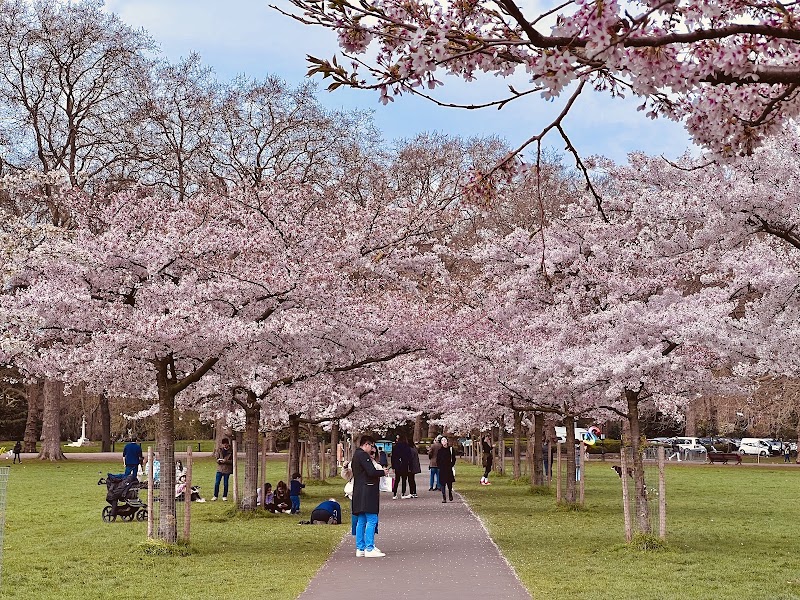
Spring starts with bulbs along the woodland walk and blossom around the lake, and by May the Old English Garden is filling out. Summer is peak season: the Sub-Tropical Garden is planted out and at its most theatrical, boats are on the lake, the bandstand hosts concerts, and the riverside fills in the evenings. Autumn brings strong colour through the woodland walk and the quietest weekday mornings of the year, with mist over the lake and the pagoda catching low light. Winter suits the park’s structure — bare avenues, waterfowl concentrated on the lake, the Winter Garden doing its job with stems, bark and scent, and the clearest views across the river to Chelsea. Buddhist ceremonies at the pagoda, including observances marking Hiroshima Day in August, are worth timing a visit around.
Good to know
Before the park existed this was Battersea Fields, low-lying market gardens and marsh with a raffish reputation built on Sunday fairs, gambling, drinking at the Red House tavern and duelling. The most famous duel took place on 21 March 1829, when the Duke of Wellington — then Prime Minister — met the Earl of Winchilsea over Catholic emancipation; Wellington fired deliberately wide and Winchilsea discharged his pistol into the air. Reformers campaigned for the ground to be turned into a public park, and the Battersea Park Act followed in 1846. Sir James Pennethorne laid it out between 1846 and 1864, raising the marshy ground with vast quantities of spoil excavated from dock works downriver, and the park opened in 1858 once Chelsea Bridge was complete. John Gibson’s Sub-Tropical Garden of 1863 made it a national horticultural talking point. On 9 January 1864 the park hosted the first exhibition match played under the newly written rules of the Football Association, with sides led by Ebenezer Cobb Morley and Charles Alcock. In the 1890s it became the fashionable place to be seen on a bicycle during the cycling craze. For the Festival of Britain in 1951 the eastern end was transformed into the Festival Pleasure Gardens, designed with contributions from John Piper and Osbert Lancaster and famous for the Guinness Clock and a funfair whose Big Dipper closed permanently after a fatal accident in 1972. Between 1948 and 1966 the park hosted Britain’s first open-air sculpture exhibitions, which is why Moore and Hepworth pieces remain in the landscape. The London Peace Pagoda was offered to the city in 1984 during the Greater London Council’s Peace Year and completed the following year by a team of around fifty monks, nuns and volunteers following the teaching of Nichidatsu Fujii. The park is registered Grade II* by Historic England.
Visitor tips
- Approach the Peace Pagoda from the riverside walk rather than from inside the park — the reveal of the gilded Buddhas against the Thames is far stronger that way, and the terrace is quietest early in the morning.
- The ornamental gardens close before the main park gates do, so leave the Old English Garden and the Sub-Tropical Garden for the middle of your visit rather than the end.
- Bring cash or a card for the concessions — boats, the zoo and the ropes course are run by separate operators with their own seasons and opening days, and several close or reduce hours in winter.
Questions & answers
Is Battersea Park free to enter? Yes, the park and the Pump House Gallery are both free. The children’s zoo, boat hire, the treetop adventure course and crazy golf are run as separate ticketed concessions inside the park.
What is the Peace Pagoda and can I go up to it? It is a Buddhist stupa completed in 1985 by monks, nuns and volunteers of the Nipponzan-Myōhōji order, carrying four gilded Buddhas representing birth, enlightenment, first teaching and death. The terrace is open to everyone, free of charge, and visitors are asked to treat it as a place of quiet.
Can you hire boats on the lake? Yes, in season. Rowing boats and pedalos operate from the boathouse in the warmer months, and the operator sets its own hours, so it is worth confirming before travelling specifically for that.
Which station is closest? Battersea Park and Queenstown Road (Battersea) are the nearest National Rail stations, and Battersea Power Station on the Northern line is a similar walk. A river bus pier at the power station gives an alternative approach by water.
What is the sub-tropical garden and when is it worth seeing? It is the first public sub-tropical garden in Britain, created in 1863 by John Gibson, and it is planted out each year for summer display. Late June through September is when the large-leaved exotics reach full effect.
Are dogs allowed? Yes, under control. They are excluded from the children’s zoo, the playgrounds and the sports pitches, and dog owners are asked to keep away from the ornamental beds and the wildfowl on the lake.
What is there for teenagers and adults who want to be active? The Millennium Arena athletics track, all-weather pitches, tennis and bowls, a trim trail, cycle hire including adapted machines, and a high-ropes course strung through mature trees.
Is the park accessible? Broadly yes — the ground is flat, the main paths are surfaced, accessible toilets are provided, and the cycle hire operation runs adapted and recumbent machines specifically for riders who cannot use a standard bicycle.
Photos
Show 1 more photos
Visitor reviews
Reviews last updated: 2026-08-04 08:22:20
Data is refreshed monthly. Sources: londoname.com and editorial picks based on reviews.
A beautiful large park where you can take a walk, sit on a bench and breathe the fresh air on your own. Near the park there's Battersea station, where it's also interesting to have a wander amid the already well-develope…
A very large and beautiful park. There are toilets and playgrounds for children. Lots of birds on the lake.
A wonderful park with a view of the Thames; bear in mind, the parking is a touch on the pricey side.
A beautiful park by the Thames. Lots of interesting spots
A lovely, large park. There's a lot of interesting things to see.