

The issue of providing electricity to populated areas has been and remains relevant, as it is an important resource for human life and development. After all, it is a way to solve a large number of problems in various spheres of life. The opening of the Edison Electric Light Station in London was such a case. What were its features? What was the history of its development? Why was that facility short-lived? Learn more at londonname.
Prerequisites for the establishment of a power plant
Until the 1860s, street and indoor lighting was powered by gas throughout Great Britain. However, it was quite dangerous and caused a large number of fires. Therefore, people began to pay attention to alternative sources of lighting in the second half of the 19th century. At that time, a wave of various experiments swept across the country. However, most of those attempts were ill-conceived and their realisations were troublesome. Electricity supply was more like a short-term demonstration, and for a long time, it wasn’t a common and available resource for the masses. Another impetus for the creation of the Edison Electric Light Station was the invention of the incandescent lamp with a carbon filament. It meant that changes in this area were inevitable and, at the same time, necessary for the inhabitants of the cities of Great Britain.
Features of the idea
The famous American inventor Thomas Edison opened a test centre in New York in 1882. Its main purpose was to demonstrate the functions of an incandescent lamp. It was proved that the technology can be used for both street lighting and private use. Edison’s partner, Edward Hibberd Johnson, was also fascinated by this idea. Having joined efforts, the inventors achieved the desired result and created the first coal-fired power plant that produced electricity for public use. They decided to build it in London. However, at first, the Edison Electric Light Company encountered some difficulties in laying underground cables. It became an important issue, but at the beginning of January 1882, they reached an agreement with the authorities of the capital of Great Britain. Both parties agreed that the laying of the cables on the territory of the Holborn Viaduct would be appropriate. Moreover, most of the cables would be laid in the mines, which excluded the need for additional excavations. Thus, later, the Edison Electric Light Station was generating electricity for a large part of the city.
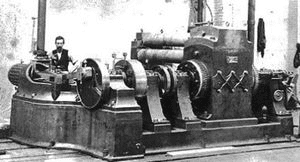
The technologies used to create the power plant were quite interesting and innovative at that time. The whole mechanism was based on two steam engines. They were a kind of driving force because they powered a large generator. In general, energy was generated from steam using Porter-Allen steam engines. During the first start-up of the power plant, it supplied 968 lamps. In particular, the generated energy powered 145 lanterns from Holborn Circus to St. Martin’s Le Grand. A large number of restaurants, shops, hotels and other establishments were also illuminated thanks to the operation of the power plant. Moreover, according to the cable laying agreement, electricity was supplied free of charge for the first three months. After the end of this period, people had to pay for electricity as they did for gas. After some time, the number of lamps that received energy from the power station increased to 3,000. Despite such success, later, the Edison Electric Light Station started to suffer losses and ceased its work in 1886.