

London is no stranger to events celebrating the natural world. These vary in their purpose, scale, duration, and frequency, but the capital truly offers something for every taste. Some events, like London Climate Action Week and other environmental initiatives, are vital to the city’s future. They pave the way for crucial changes in protecting and preserving our environment. However, many events are purely for entertainment. The London Boat Show once fell into this category, always sparking public discussion. Its eventual cancellation caused quite a stir. So, what is the story behind this iconic event, and what made it so special? More on this at londoname.
A Remarkable Journey
The history of the London Boat Show is filled with fascinating moments. Its long journey began back in 1955. It’s fair to say this was an excellent time for new concepts. With the world recovering from the Second World War, people were eager for fresh experiences. The event not only showcased unique boats but also introduced countless people to a new hobby. Over its long history, the show also moved venues several times.
The first London Boat Show took place at Olympia London, a well-known exhibition centre and event space. There, visitors had the chance to see a twin-hulled speedboat, a remarkable sight at the time. The inaugural exhibition was a huge success. By 1957, the event had moved to the Earls Court Exhibition Centre. The show was growing at a remarkable pace, attracting more people each year with increasingly impressive exhibits. As the format evolved, it was no surprise that the event relocated to a venue famous for hosting major international gatherings. During its heyday, the Earls Court Exhibition Centre played a significant role in the nation’s economy, contributing an estimated £2 billion at its peak. In this new location, the pressure was on to impress visitors. The 1957 show delivered, featuring a wide array of original craft, including hybrid boats and the famous Bluebird. Another new feature at Earls Court was the use of a large indoor pool, which allowed the boats to be displayed more realistically on the water.
Throughout the late 20th century, the London Boat Show continued to expand and surprise visitors with new exhibits. In 1959, for instance, Mike Hawthorn’s hydroplane was a star attraction. The 1960s brought even more advanced and modern displays, including new engines and dinghy simulators. By 1979, the impact of technological progress was becoming more apparent, perfectly demonstrated by a popular windsurfing simulator.
An Unexpected End
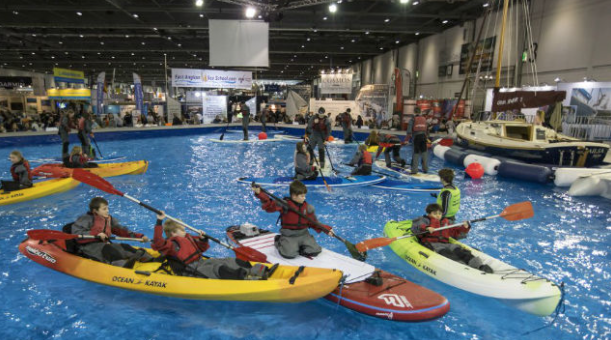
Overall, the London Boat Show had a rich and fascinating existence, regularly attended by famous faces from the worlds of acting, music, sports, and business. In the early 21st century, visitor numbers hovered around 100,000 annually, but in 2004, the show attracted a record 213,800 people. This surge in popularity was largely due to its relocation that year to ExCeL London. The new exhibition hall, situated on the northern quay of the Royal Victoria Dock, was a perfect fit for the event. Here, visitors could see everything from traditional boats to smaller vessels like kayaks, dinghies, paddleboards, and canoes. The show was always organised by British Marine, the trade association for the leisure marine industry. It typically ran for ten days, but in 2018, the schedule was cut to five. Later that same year, the show was cancelled for good, due to an outdated format and a lack of commercial viability.