

London can boast of many interesting places where you can enjoy incredible nature and have a good time alone, with friends or family. Some of those beautiful green spaces have an interesting history of creation and further development. Usually, such places are filled with an incredible atmosphere. The very idea that you are in a spot that has witnessed various important historical events is impressive and exciting. London’s Richmond Park is such a location. This is one of the largest parks in the city, which has national and international importance for the preservation of wild nature. What are the main features of this place and what is its history? Learn more at londonname.
Creation of the park and plague outbreak
The initial stage of the park development was the move of Charles I and his entire court to Richmond Palace. It happened in 1625 due to the plague epidemic raging in London. The territory around the palace served for deer hunting. The park remained a hunting location for quite a long time. Later, the park was repeatedly undergoing changes when new rulers were coming to power. It also affected the permission for public visits to this area. The place was open to the public in 1872. Deer have remained the main feature of the park since its foundation. In 1861, the site acquired new drainage systems, including certain locations with water for deer. In 1915, some plots of the park were allocated for football and cricket fields. A little later, a golf course was created here too. Since 1923, there has been a golf course, which is available to ordinary residents and guests of the city. Richmond Park played an important role during the First World War. It housed cavalry training. A military camp with a total area of 18 hectares was located on the territory of the park in 1938. It was engaged in the training of new recruits. From August 1941, the camp was used as a military convalescent depot. After that, the base of the Auxiliary Territorial Service was located here until the end of the war. In addition, a large part of the park’s territory was used for agricultural activities. After the end of the war, the park resumed its usual functions. Today, its territory is often used for sports events and competitions, such as the cycling competitions of the 2012 Olympic Games.
Surprising features of the park
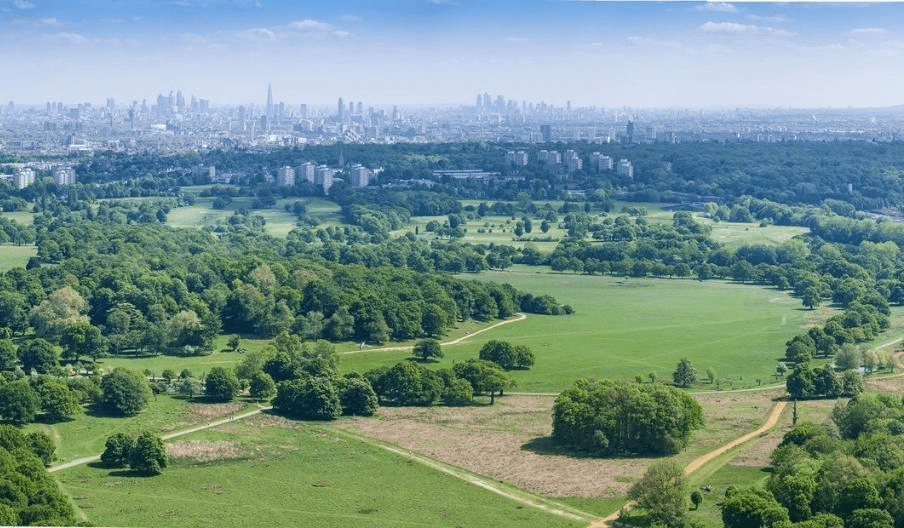
First of all, Richmond Park is considered one of the most popular in Great Britain because of deer and other animals that still live on its territory. It plays a big role in wildlife preservation and attraction of visitors. There are also a lot of architectural buildings of historical importance. It is the second-largest urban park in the country. There is a walking route that allows visitors to see all the local gems. In addition, you can go cycling on the main roads. As Richmond Park is a national nature reserve and Site of Special Scientific Interest, dog owners are responsible for keeping their animals under control while in the park. There are some rules about this. In 2009, there was an incident when a dog bit several birds. In general, before visiting this place, it is better to familiarise yourself with the rules on how best to behave with the animals that live here.