

Park · London · ⭐ 9.5/10 · 63286 reviews · updated: 2026-08-04 08:22:16
Address: London SW1A 2BJ, United Kingdom
St James’s Park — the oldest Royal Park, and the one with the pelicans
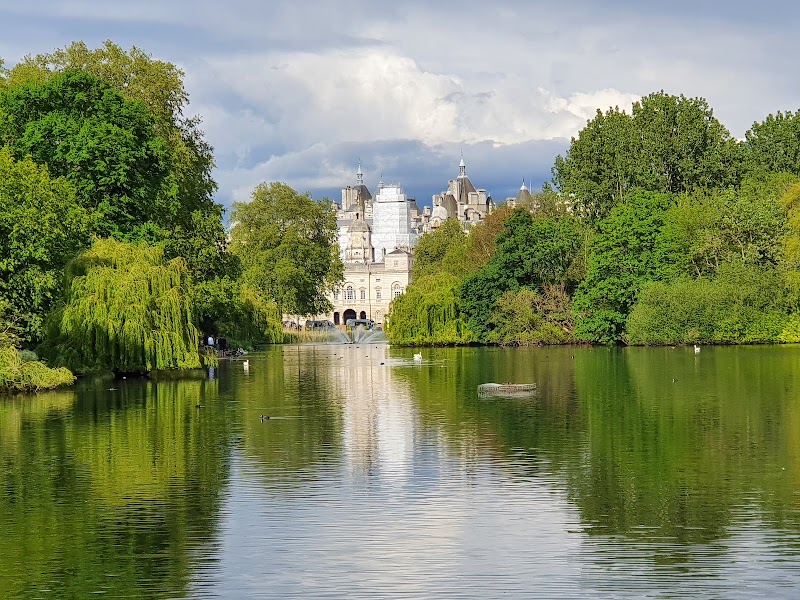
Fifty-seven acres of lake, willow and lawn, wrapped by Buckingham Palace at one end and Horse Guards at the other, make this the smallest of the central Royal Parks and by a wide margin the most photographed. It is also the oldest: Henry VIII bought the marsh here in 1532, and every monarch since has left a mark on it. The single view from the bridge over the lake — the palace framed in trees to the west, the pinnacles and domes of Whitehall to the east — is the most reproduced park view in Britain, and it exists because John Nash bent a straight seventeenth-century canal into a curve in 1827. The pelicans have been here even longer than the curve.
Highlights
- The pelicans — a Russian ambassador presented pelicans to Charles II in 1664, and the colony has been unbroken ever since, over 360 years. They are great white pelicans, fed on roach, tench, carp and trout at around half past two each afternoon near the keeper’s cottage. In May 2026 four chicks hatched here — the first ever born in the park, because pelicans normally breed only in far larger colonies.
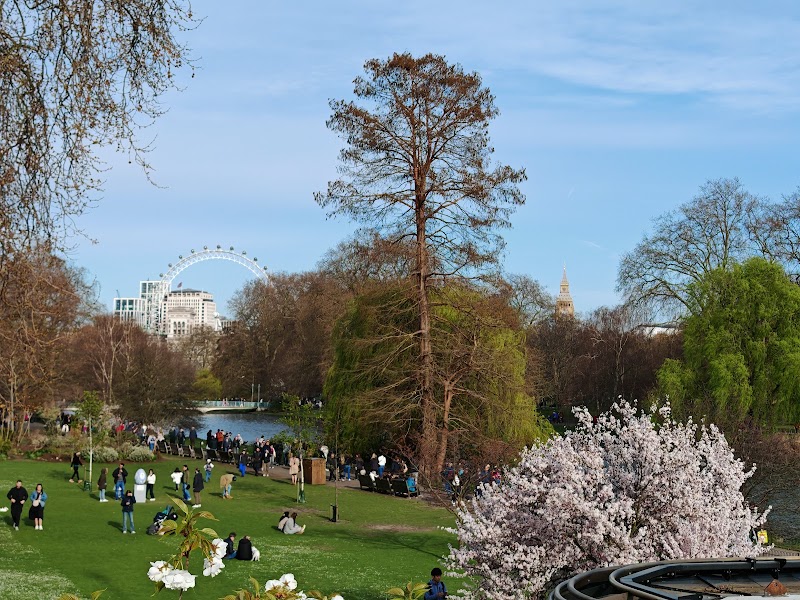
- The Blue Bridge view — from the middle of the lake crossing you get Buckingham Palace framed by trees in one direction, and in the other the roofs of Horse Guards and Whitehall Court with the London Eye and the Shard rising behind them. It is the reason most visitors come, and it works at any hour.
- Duck Island — a wooded island at the eastern end of the lake, closed to people and left to the birds. It has been a bird sanctuary since the seventeenth century, when Charles II appointed a “Governor of Duck Island” as a real salaried post.
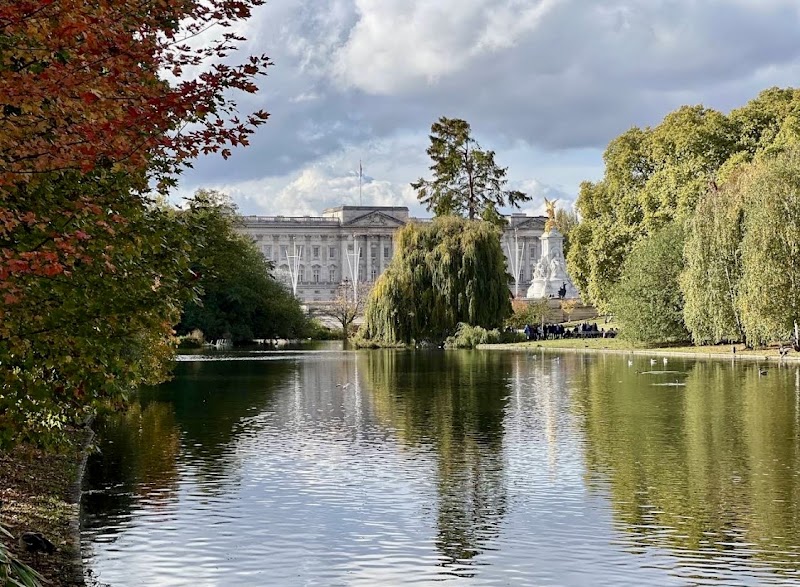
- The Victoria Memorial — Sir Thomas Brock’s monument to Queen Victoria, built between 1906 and 1911, in white marble and gilt bronze at the western end where the park meets the palace forecourt. It is the pivot of the whole ceremonial layout.
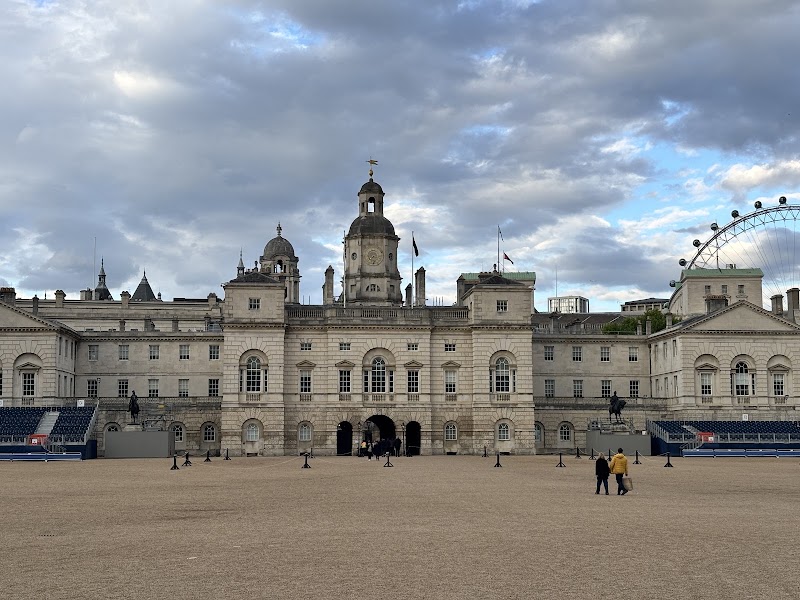
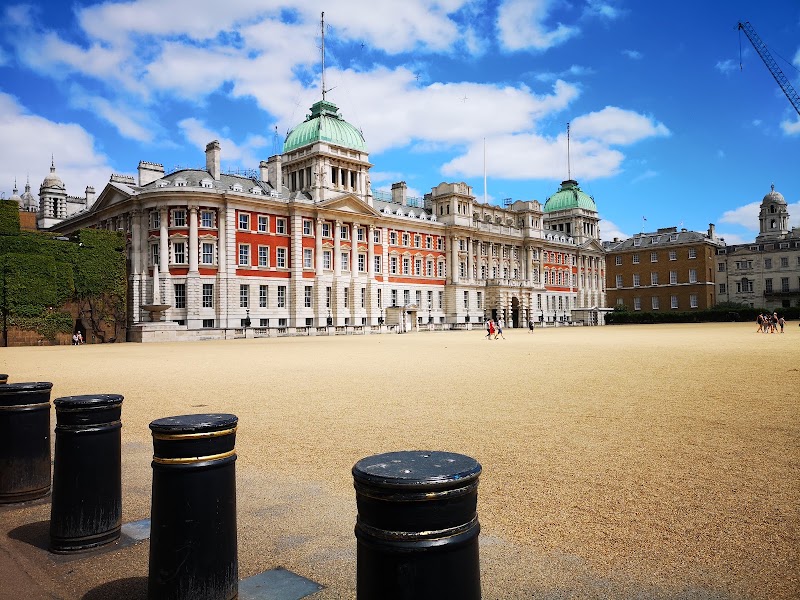
- Horse Guards Parade — the vast gravel parade ground on the eastern edge, where Trooping the Colour is staged each June for the sovereign’s official birthday and where the Household Cavalry mount guard daily.
- The two fountains — the Swire Fountain north of Duck Island and the Tiffany Fountain on Pelican Rock to its south, both playing over the lake and both favourite perches for the birds.
What you’ll find
The park is small enough to see completely in an hour, and dense enough that almost nothing in it is filler. Everything sits around the lake.
- The lake and its two islands — West Island and Duck Island, with the water shaped by Nash into an irregular curve in 1827 out of the dead-straight ornamental canal, 775 metres long and 38 metres wide, that Charles II had dug in the 1660s.
- An unusually varied bird population — besides the pelicans there are black swans, mute swans, shelducks, tufted ducks, pochards, coots, moorhens, grey herons and a large gull population; the collection has been managed as an ornithological one, not an accident, for centuries.
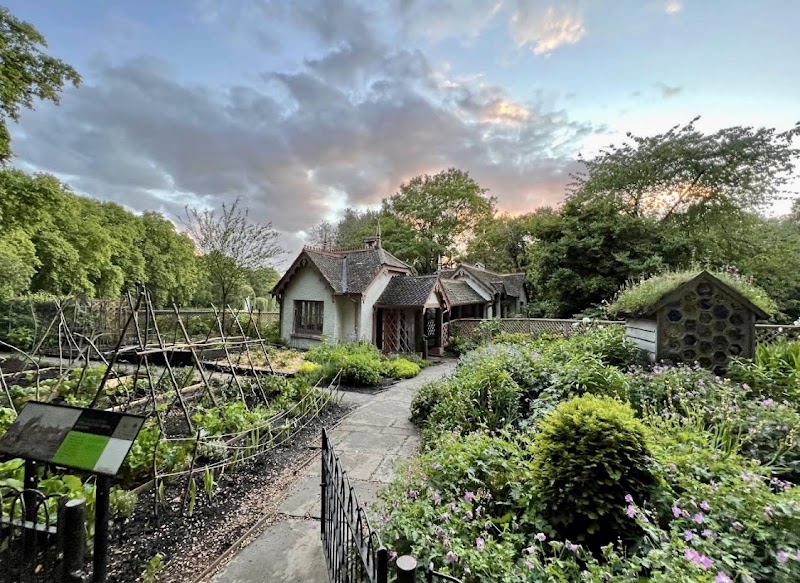
- Duck Island Cottage — a picturesque lakeside cottage of the 1840s built for the Ornithological Society of London, still standing and still connected with the birds; the lake’s pumps and water-treatment machinery are housed nearby. In the late nineteenth century Scotland Yard, oddly, kept a bomb-disposal facility on the island, and the bird-keeper handled the devices.
- Notable trees — mature London planes, a scarlet oak, a black mulberry and a fig, plus the weeping willows along the water that define every photograph of the place.
- Memorials on the eastern side — the Guards Memorial of 1926, by the sculptor Gilbert Ledward, with five bronze guardsmen cast from guns captured in the First World War, facing the parade ground; the RAF Memorial and the Citadel, the ivy-clad concrete bunker built in 1940–41 for the Admiralty and never demolished.
- Family facilities — a children’s playground with a large sandpit, a lakeside café, deckchairs in season, and flat surfaced paths throughout.
Things to do — and who it’s for
- First-time visitors to London — no other single walk links Buckingham Palace, Horse Guards, the Victoria Memorial and a view of the Whitehall skyline in under twenty minutes without touching traffic.
- Birdwatchers and families — the daily pelican feeding is a genuine event with a keeper, an audience and a stated time; add the black swans and the heronry activity and there is more identifiable wildlife here than in parks ten times the size.
- Ceremony hunters — Changing the Guard, the Household Cavalry mounting guard, gun salutes on royal anniversaries and Trooping the Colour in June all happen on or immediately beside the park.
- Photographers — early morning gives mist on the lake, empty bridges and low light on the palace; blue hour gives the floodlit Whitehall skyline reflected in still water.
- Office workers and short-lunch visitors — a full circuit of the lake takes about twenty-five minutes, which makes this the most efficient green break in Westminster.
- Visitors with limited mobility or with pushchairs — the park is flat, compact and entirely surfaced, with benches and deckchairs at short intervals and no significant gradients anywhere.
Getting there & practical
The park sits in Westminster, in the heart of official London, with Buckingham Palace at its western end, Horse Guards at its eastern end and the government quarter along the northern and southern edges. St James’s Park station on the Circle and District lines is closest to the southern side. Westminster on the Circle, District and Jubilee lines serves the eastern end and Parliament. Green Park on the Piccadilly, Victoria and Jubilee lines is nearest to the palace end. Charing Cross, with the Bakerloo and Northern lines and mainline trains, and Victoria, with the Circle, District and Victoria lines, national rail and coaches, are both a short walk. A great many bus routes pass along the surrounding roads, and the park is an easy walk from Trafalgar Square and Parliament Square. Entry is free and unrestricted; you pay only if you take a deckchair or eat at the café, and separately for paid attractions nearby such as the State Rooms at Buckingham Palace, which open only for part of the year. The park is open from 5am to midnight every day — like Hyde Park and Green Park it does not close at dusk, unlike the outer Royal Parks such as Greenwich and Richmond, whose closing times shift month by month. Allow forty-five minutes for a circuit with photographs, an hour and a half if you want to catch the pelican feeding, and half a day if you are combining it with the ceremonial events.
When to visit
Spring is when the park is at its most extravagant: hundreds of thousands of bulbs come out in sheets along the lakeside, the willows go pale green, and the waterfowl breed on the islands. Summer brings the full ceremonial calendar — Trooping the Colour in June, the state visits, the deckchairs and a great many people; the middle of the day between June and August is genuinely crowded and the pelican feeding draws a real crush, so come at opening time if you want the bridge to yourself. Autumn is the connoisseur’s season: the planes turn, the light gets long and gold across the water, and the crowds thin sharply after the school holidays end. Winter is short on daylight but strong on atmosphere — the lake reflects the floodlights on Whitehall from mid-afternoon, gulls and wildfowl concentrate on the open water, and the surrounding buildings are lit until late. There are no deer in this park, so none of the rutting-season restrictions that apply in Richmond and Bushy are relevant here; the only wildlife caution is to keep dogs on a lead near the lake, especially while the young pelicans are still on the water.
Good to know
In 1532 Henry VIII bought a marshy field from Eton College, drained by the Tyburn stream, and built St James’s Palace beside it as a hunting lodge; the ground became a deer park attached to the palace. James I turned it into something closer to a menagerie after 1603, draining and landscaping it and keeping camels, crocodiles, an elephant and exotic birds, the aviaries eventually giving the southern boundary its name. The transformation that shaped the park came with Charles II. Returning from exile in France in 1660, he had the ground remodelled in the formal French manner, probably by the designer André Mollet, with a straight ornamental canal 775 metres long and avenues of trees, and — crucially — he opened it to the public and walked in it himself, feeding the ducks and talking to anyone. In 1664 a Russian ambassador gave him pelicans, and the colony has never lapsed. For the next century and a half the park was a working piece of London as much as a royal one: cows were grazed on it and milk sold fresh from a stall known as the Lactarian, recorded by the German traveller Zacharias Conrad von Uffenbach in 1710. In August 1814 the Grand Jubilee marked the end of the Napoleonic Wars with John Nash’s Chinese-style bridge and a seven-storey pagoda over the canal; the pagoda caught fire during the fireworks and burned. Between 1826 and 1827 Nash returned, this time commissioned by George IV, and remade the park in the picturesque English manner: the canal became the irregular lake seen today, the formal avenues became winding walks, and the whole ceremonial axis linking the palace to Whitehall was set. The Mall was opened to ordinary traffic in 1887, sixty years later. In the First World War the lake was drained and temporary civil service offices built over it; both were removed afterwards. In 1940 and 1941 the Admiralty raised the Citadel, a bomb-proof concrete block at the eastern end, which was left standing and planted with ivy. Most recently, in 2025 a national memorial to Queen Elizabeth II designed by Foster + Partners was selected for the park, which will bring the first major change to Nash’s layout in nearly two centuries.
Visitor tips
- Pelican feeding is usually around 2.30pm near the keeper’s cottage, but keepers sometimes start early and the birds set the pace. Arrive fifteen or twenty minutes ahead if you want to be able to see anything.
- The bridge over the lake is the single best viewpoint and it is busy from mid-morning. Before nine or after seven in summer you will usually have it almost to yourself, and the reflections are better.
- If you are here for ceremony, check the calendar first. Changing the Guard does not run every day in every season, and Trooping the Colour in June closes large parts of the eastern end and the parade ground to the public.
Questions & answers
Is entry free? Yes, entirely, and it has been open to the public since the reign of Charles II in the 1660s. Charges apply only to optional extras such as deckchairs and the café, and to separate paid attractions in the area.
When are the pelicans fed? Ordinarily in the middle of the afternoon, around half past two, near the keeper’s cottage on the lake’s eastern side. Times can shift, and extra feeds have been added since the chicks hatched, so treat it as approximate rather than a fixed timetable.
How long have there been pelicans here? Since 1664, when a Russian ambassador gave a pair to Charles II. The colony has been continuous for more than 360 years, which is why the four chicks that hatched in May 2026 mattered — they were the first ever hatched in the park, as pelicans usually breed only in large colonies with enough birds to protect the eggs.
What are the opening hours? Five in the morning until midnight, every day of the year. St James’s Park is one of the Royal Parks that does not close at dusk; the outer parks such as Greenwich do, with the closing hour moving each month.
Can I see Buckingham Palace from the park? Yes — the classic view is from the bridge across the lake, looking west, with the palace framed by trees and the Victoria Memorial in front of it. The palace forecourt and the memorial are at the park’s western end; the State Rooms inside the palace are a separate ticketed attraction and open only in certain months.
How long does it take to walk round? About twenty-five minutes for the lake circuit at an easy pace, forty-five with photographs, and an hour and a half if you stop for the pelicans and the memorials.
Is it suitable for small children and pushchairs? Very. The park is flat and fully surfaced, there is a playground with a large sandpit, distances are short, and the birds hold children’s attention better than almost anything else in central London.
Which park is this compared with Green Park and Hyde Park? The three run into one another in a chain. St James’s Park is the eastern and smallest, with the lake, the birds and the palace views. Green Park in the middle is plain grass and mature trees with no flowerbeds and no water. Hyde Park, beyond it, is by far the largest and the most varied. You can walk all three end to end without crossing more than a couple of roads.
Photos
Show 1 more photos
Visitor reviews
Reviews last updated: 2026-08-04 08:22:16
Data is refreshed monthly. Sources: londoname.com and editorial picks based on reviews.
A very beautiful and large park. And it's right by the centre and everything you might be looking for. Buckingham Palace is nearby too. And that little squirrel in the video made us fall in love. It was so sweet. There a…
A mass of different tourists mixed in with locals create a festive feeling. You can rest sitting on the benches or on the grass.
Squirrels, ducks, geese, swans and another fifty-odd species of animals and birds calmly live in the centre of London the life of ordinary Britons.
You can pet them! You can feed them! You can photograph them! You can sl…
A very beautiful park with a pond in the middle, with nice, clean paths. There are lots of squirrels that aren't afraid of people at all, there are pelicans, swans, ducks. A wonderful place to relax, walk or run.
St James's Park is my favourite corner of nature in the centre of London. Incredible landscapes, blooming flower beds and a picturesque lake with ducks and pelicans create an atmosphere of calm. The best place to relax w…