

London and its surroundings are known for their incredible scenery. Local landscapes are unique and incomparable. Therefore, many tourists dream of spending a few days just wandering around the beautiful places, fully enjoying nature and incredible views. Learn more at londonname.
Of course, as many other cities, London has a variety of parks, squares and nature reserves. All of them impress visitors with their beauty and maximum naturalness. In such places, you can truly realise the value of nature and its gifts. Water bodies have always occupied a special place in such areas.
The Long Water is a famous recreational lake in London. Its history began in the distant 1730s. Since then, this amazing reservoir has been decorating Kensington Gardens and attracting attention with its beauty and landscape.
Beginning of the story
In 1730, Queen Caroline issued a decree to dam the Westbourne River in Hyde Park. It was necessary for the reconstruction of the park.
Initially, there were several monastic ponds on that territory. However, during the redevelopment, everything changed significantly and a single lake appeared.
Merger
Thus, during the 1730s and 1732s, natural ponds were merged into one reservoir, the Long Water Lake. It was created due to the damming of the Westbourne River. Later, another large pond was dug in the territory of Kensington Gardens, so that it would become the centre of the park area.
Most of the work was led by the royal gardener Charles Bridgeman.
Before the reconstruction and creation of a single reservoir, the local ponds had a straight and long shape.
Important task
The main task of creating a single lake was to make it as natural as possible. Therefore, it was designed in such a way to hide its artificiality.
Tragic accident
The new lake acquired bad fame in 1816. Then the drowned body of the poet Percy Bysshe Shelley’s pregnant wife was found in the reservoir.
That event greatly worried the local population and people got afraid of the lake.
New rules
When the Hanoverian rule celebrated its centenary in 1814, the Long Water became a real centre of festive events.
When the country began to open museums and hold numerous exhibitions, stricter environmental regulations were introduced for the lake and the entire park area.
Changes
Speaking about the history of the lake, it should be noted that in the 1820s the place experienced significant changes. At that time, the city constructed the Serpentine Bridge there, which divided the lake into the eastern and western parts.
Attractions
Interestingly, the northern part of the Long Water is decorated with five fountains surrounded by classical statues and sculptures.
A memorial to Edward Jenner is considered one of the main figures of the composition. Initially, it was located in Trafalgar Square, but it was moved to the park in 1862.
Bird habitat
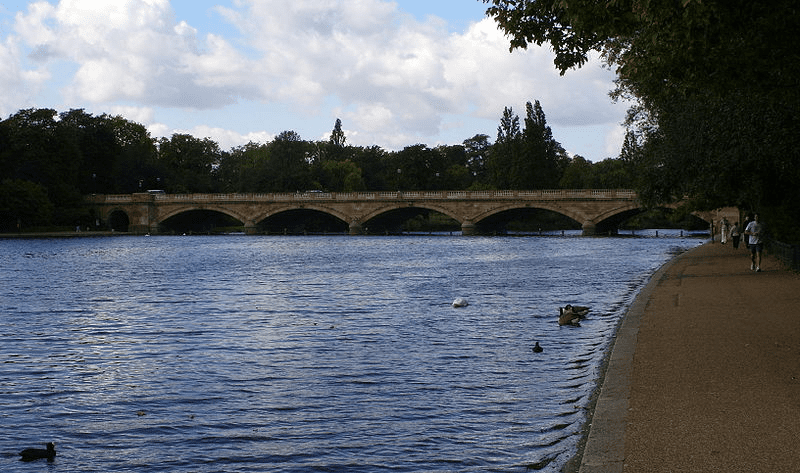
The Long Water is also a bird sanctuary. It became a permanent habitat for populations of waterfowl. In winter, it replenishes with migratory species. Then the lake becomes even more lively and popular. A lot of people are interested in observing various birds in natural surroundings.
Photo source: wikipedia