

The issue of nature preservation and human impact on the environment has always been quite important for the London government and its residents. Most people are aware that they should take some measures. Thus, the city became a kind of generator of various ecological ideas. The creation of a plant that can produce energy from recycled garbage was one of them. What were the prerequisites for such a decision? What is the history of the plant? What are its main features? Learn more at londonname.
History full of controversy
The construction of the plant caused a whole series of discussions and demanded decisive actions. In general, the first proposals to create such a place arose back in the 1990s. However, at that time, there were many problems related to the transport interchange and the size of the facility. After a few years, the city started talking about the implementation of the project again. However, then local authorities and former London Mayor Ken Livingstone tried to block the construction and started a trial against it. It was believed that the creation of the plant would provoke a significant amount of electricity consumption. Therefore, two public investigations took place in 2003 and 2005. In 2006, the construction of the plant was officially approved by the Secretary of State for Business and Trade. In 2007, the court rejected a claim by Bexley Council and Ken Livingstone. Then there were several more disputes and new lawsuits, but in the end, the official opening of the plant took place in 2012. The facility became a good alternative to Cory’s Mucking Landfill, which was decommissioned in 2010. Previously, the modern area of the plant housed a Borax chemical plant. The facility is located on the south bank of the Thames. Thus, the issue of waste transportation was resolved, as garbage is transported on tugs and barges. Moreover, representatives of the facility ordered four new Shoalbuster 2208 tugs. During the plant construction, the nearby highway also underwent restoration.
Features of the plant functioning
The main technology of the plant operation is incineration of waste. Such a process leads to heat released, which is later used to obtain energy. The burning temperature is more than 850°C. Waste is incinerated in highly efficient combustion units. Waste heat recovery from flue gases takes place in special boilers. Later, thermal energy is converted into electrical energy with the help of steam turbines. Such a turbine can produce approximately 66 MW of electricity and 30 MW of steam. Initially, the power reaches 11 kV. However, to export electricity to the general network, the voltage is increased to 132 kV.
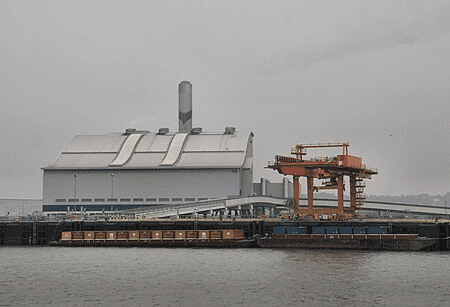
The plant processes waste from the central and western parts of London. From time to time, the plant concludes other commercial contracts for waste disposal. Garbage transportation is an important aspect of the plant functioning. Thanks to the improvement of transport routes, it takes a relatively small amount of time and also provides comfortable conditions. The amount of energy produced by the plant can power 66,000 homes. The facility demonstrates such indicators thanks to the annual processing of almost 585,000 tons of unnecessary garbage generated in the region. So, in fact, the plant not only disposes of garbage (which would harm the environment otherwise) but also generates electricity, which is important for our lives.