

There is a place in London where you can learn about extinct animals and the natural world that surrounded humanity many years ago. The Grant Museum of Zoology and Comparative Anatomy has an incredible atmosphere. The museum is of great value to modern researchers. For ordinary residents of the city and tourists, it becomes a place of rest and cultural enrichment in general. Families often come here to discover a new, completely different world. Not only children but also adults are enthralled with the museum’s impressive exhibits. So, if you are in London, be sure to visit this wonderful place. Learn more at londonname.
Incredible history of the museum’s creation
The history of the museum’s creation is closely related to the famous British anatomist and zoologist. Robert Edmond Grant played an extremely large role in the development of this London museum and the scientific sphere in England in general. The scientist founded the Grant Museum of Zoology and Comparative Anatomy in 1828. Its purpose was primarily scientific research and observation. Therefore, it was open only to University College London students and scientists for a long time. There was a unique educational collection of Robert Grant. It contained a large number of zoological specimens and dissection materials. Taking into account the year the museum was founded, it becomes clear that its collection is one of the oldest in the whole of Great Britain.
Robert Grant headed the department of Zoology and was the first curator of the museum. After the scientist’s death, his collection (according to the will) became the property of this unique institution. Edwin Lankester took care of the collection in 1875. He supplemented it with many new exhibits and was also the curator of the Grant Museum of Zoology and Comparative Anatomy until 1891. Another outstanding event, which left a significant mark in the history of the institution, took place in 1996. Since then, the museum has been open to the public. Thus, not only scientists but also ordinary people could get acquainted with rare objects.
The unique world of Zoology
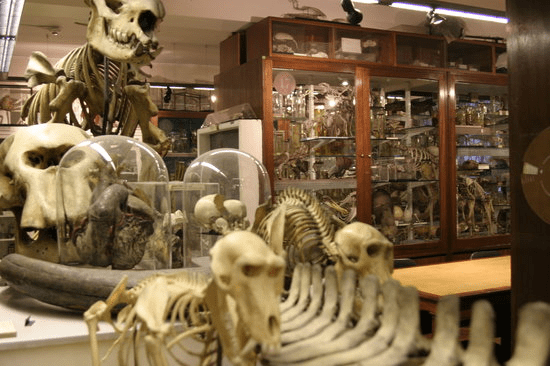
The museum fund includes the rarest exhibits, the number of which usually doesn’t exceed a few units in the world. In total, there are approximately 68,000 zoological objects. Most of them are extinct animals. For example, here you can find a subspecies of plains zebra (better known as quagga), which lived on the territory of South Africa. The museum owns one of seven existing skeletons of that extinct animal. It is believed that the last representative of that species died in 1883. Their main feature was the colour. Distinct stripes usually predominated in the front of the body, while the back was a plain brown. In the museum, you can find another rare exhibit, a thylacine, and learn about the interesting history of its development and demise. It is a dog-like marsupial that existed until the 1930s. The species was characterised by its striped back and the ability to move on its hind legs (jumping). Females and males had a pouch in which they were rearing their young. At the beginning of the 21st century, people began to kill those animals en masse because they threatened farming. The last thylacine died in one of the Australian zoos in 1936. Another interesting exhibit is Dodo bones. Unfortunately, you can’t see this flightless bird live anymore. This species was common on the island of Mauritius and was distinguished by its fairly large weight (about 20 kilograms) and size (about a metre long). There are many more fascinating exhibits that hide interesting, sometimes tragic, but informative stories in the Grant Museum of Zoology and Comparative Anatomy.