

London’s nature impresses with its beauty and uniqueness. The local landscapes and scenery won’t leave anyone indifferent, as their richness and diversity are truly admirable! Learn more at londonname.
London’s islands are a separate topic that deserves no less attention. Moreover, each of them has its own amazing story, which tells a lot about the past of a particular area.
In our article, we would like to tell you about London’s mysterious island.
We have used such an adjective because the history of the island’s name is so complicated that no one has been able to find the truth. It is still full of assumptions and riddles, which, in turn, keep a lot of secrets.
Intrigued? Then let’s read about one of the most mysterious islands in London.
General information
Oliver’s Island is a river island in the English River Thames. Its entire territory is covered with trees.
To be more precise, the island is located in the London Borough of Hounslow.
Mystery of the name
The name of the island is associated with the story that it has been a hideout for Oliver Cromwell. However, most likely, this legend is fiction.
Initially, the place was called Strand Ayt. Then the well-known myth that Cromwell set up something like a headquarters there appeared.
The highlight of the legend was a secret tunnel. However, no evidence was discovered that it really existed.
Historical aspect
If we turn to the history of the island, it is quite appropriate to mention an interesting fact.
In 1777, the London Navigation Committee installed a tollbooth on the island, which collected a toll from passing vessels. That money was needed to finance the improvement of river navigation.
The wooden booth somewhat resembled a small castle with a moored barge next to it where tolls were collected.
Interestingly, the City Barge gave the name of the hotel on Strand-on-the-Green Street.
The island housed toll barges until the shore dock was constructed.
New building
A smithy appeared on the territory of the island in 1865. Later, it was used for building and repairing barges.
Management
In 1857 the Thames Conservation Company took over the management of the island. In 1909, it was passed to the Port of London Authority.
By the way, the latter began to use a small house located on the island as a warehouse. The island shores have become something like a wharf for abandoned ships.
Failed attempt
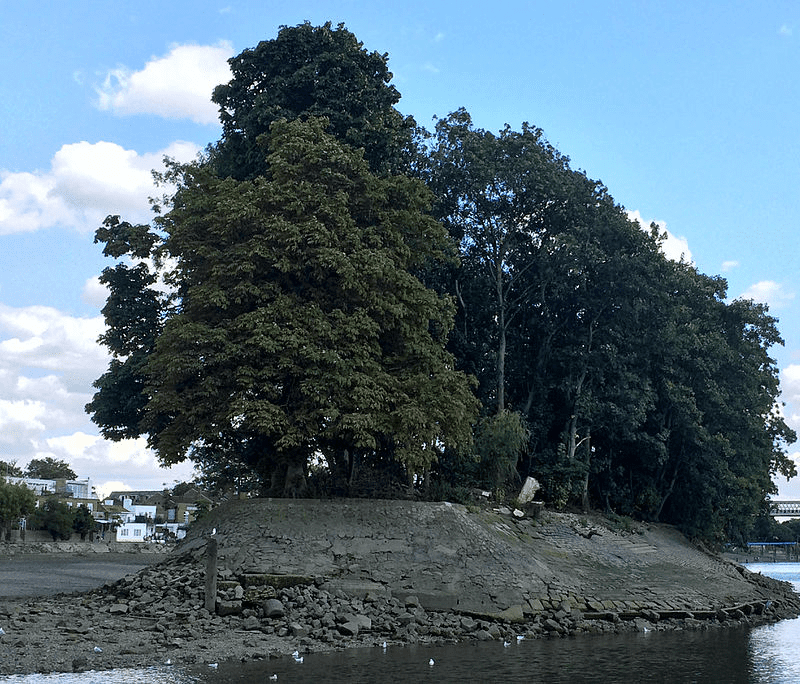
In 1971, the aforementioned administration tried to sell the island. However, this move caused many protests among the London population.
In particular, in order to prevent the sale, local residents even created a special organisation to unite all concerned. As a result, people managed to defend the island and the management refused to sell it.
Among the changes that took place a little later, it is worth noting the demolition of the smithy in 1990. From that moment, a new era in the history of the island began. This period has also been very eventful and is worth a separate article.
Photo source: wikipedia