

Park · London · ⭐ 9.5/10 · 30526 reviews · updated: 2026-08-04 08:22:19
Address: London, United Kingdom
Kensington Gardens — the palace garden that became a public masterpiece
For most of its life this was private ground: the pleasure garden of a working royal palace, laid out by the greatest designers of the age for a queen who wanted something grander than a lawn. Two hundred and sixty-five acres of avenues, formal water and old trees, it still feels ordered where neighbouring Hyde Park feels informal — a place of long straight walks, a glittering Round Pond, and a cast of monuments running from a gilded Gothic shrine to a bronze boy who arrived overnight without permission.
Highlights
- The Albert Memorial — George Gilbert Scott’s Gothic Revival canopy, opened in 1872 and rising some 54 metres, shelters a gilded Prince Albert holding the catalogue of the Great Exhibition; the plinth carries the Frieze of Parnassus with 169 carved artists and composers.
- The Peter Pan statue — Sir George Frampton’s bronze, installed in secret overnight on 30 April 1912 and paid for by J. M. Barrie himself, stands where Peter lands in Barrie’s 1902 book; fairies, mice, squirrels and rabbits climb its base.
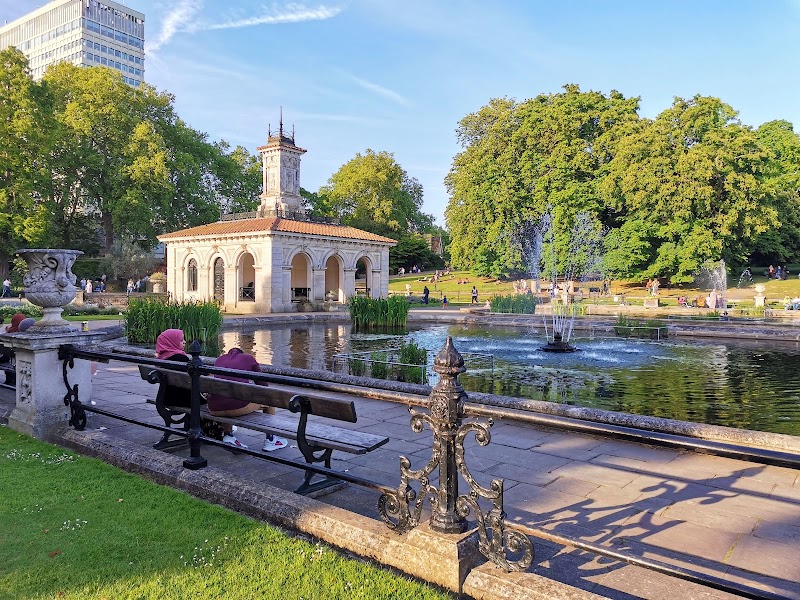
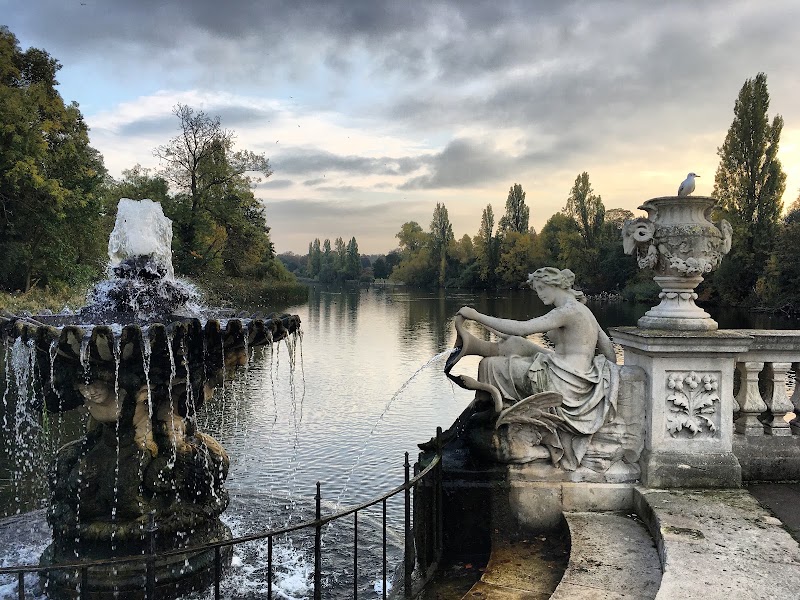
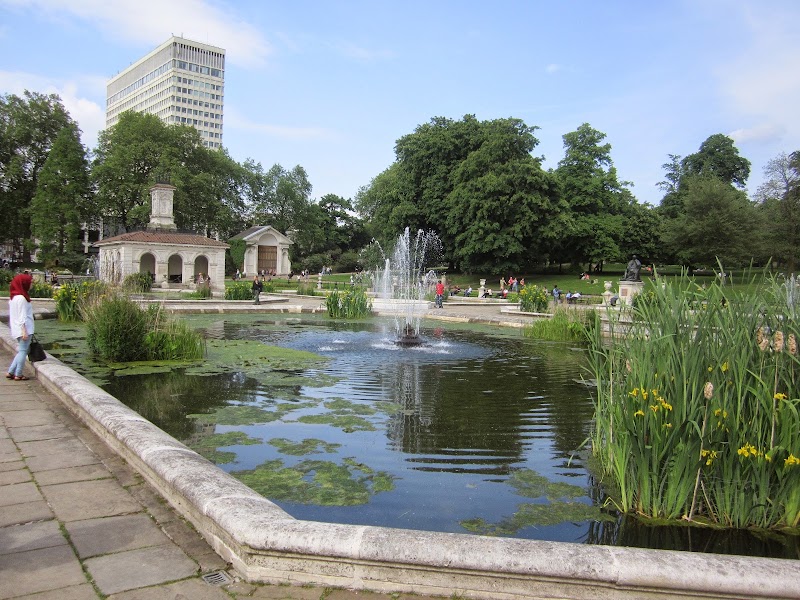
- The Italian Gardens — an ornamental water garden of the 1860s at the head of the Long Water, with four basins, a Tazza fountain and a pump house dressed as an Italian villa, understood as Prince Albert’s gift to Queen Victoria.
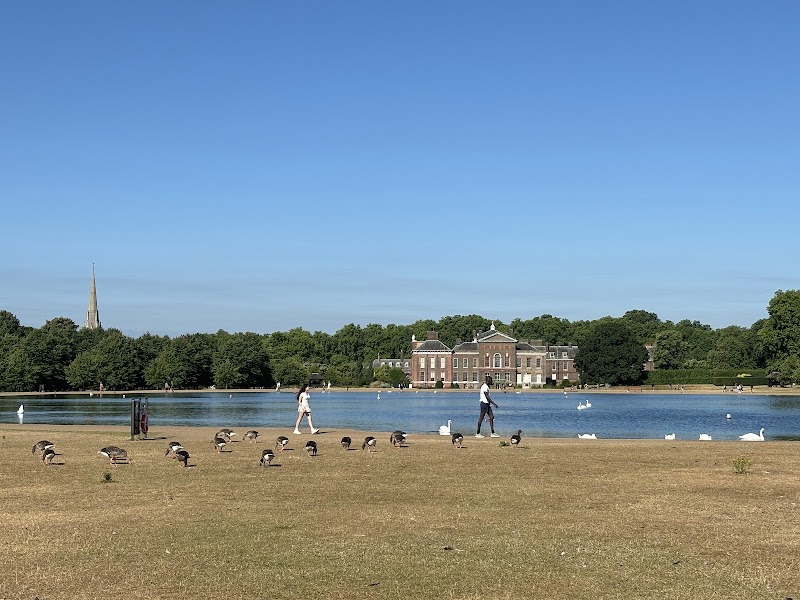
- The Round Pond — the formal circular basin laid out in front of Kensington Palace around 1728, still the gathering point for model-boat sailors, swans and low winter sun.
- The Elfin Oak — a hollow oak stump reckoned to be some nine centuries old, brought from Richmond Park and carved in the 1930s by Ivor Innes with elves, gnomes, witches and woodland animals; it is a listed structure in its own right.
- Serpentine South and the annual Pavilion — a 1934 tea pavilion turned gallery in 1970, and beside it each summer a temporary pavilion by a leading international architect, a commission running since Zaha Hadid’s first in 2000.
What you’ll find
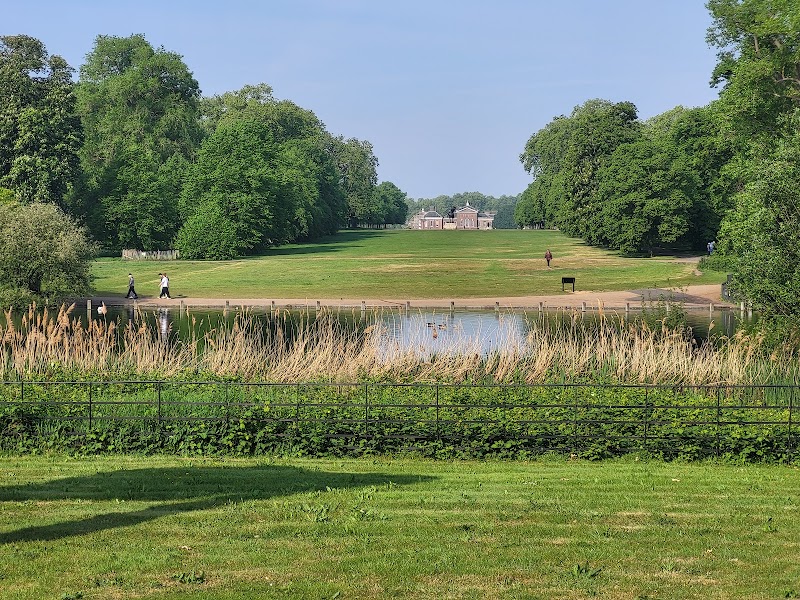
The plan is deliberately geometric — Bridgeman and Wise’s avenues radiate from the palace and the Round Pond, and the Long Water sweeps a controlled curve down to the Serpentine bridge. Between those lines sit lawns, mature limes and horse chestnuts, and a run of monuments and small gardens that reward slow walking.
- Kensington Palace and its Sunken Garden of 1908, replanted as a white garden and now the setting for the statue of Diana, Princess of Wales unveiled in 2021.
- The Long Water — the upstream, quieter half of the Serpentine, formed in 1726–31 by damming the River Westbourne, fringed with reed and popular with herons and cormorants.
- Queen Caroline’s Temple, a classical summer house attributed to William Kent and dated 1734–35, looking down over the water.
- The Diana, Princess of Wales Memorial Playground, opened in June 2000 around a huge wooden pirate ship, with entry limited to adults accompanied by a child.
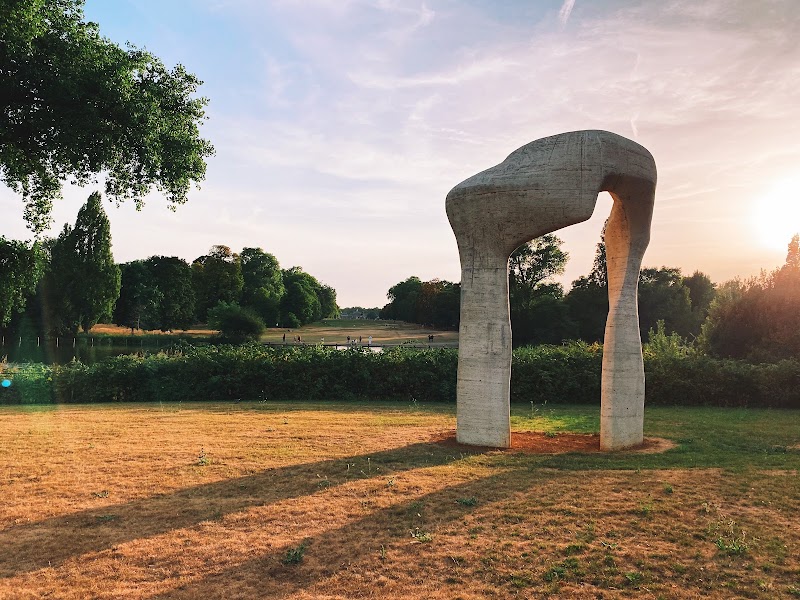
- Sculpture across the grounds: G. F. Watts’s Physical Energy of 1907, Philip Hardwick’s red granite Speke Monument of 1866, Princess Louise’s marble statue of her mother Queen Victoria of 1893, and Henry Moore’s six-metre travertine Arch of 1980.
- Refreshment points near the Italian Gardens, the palace and the gallery, plus deckchairs on the lawns in summer.
Things to do — and who it’s for
- Art and architecture lovers — the Serpentine’s two galleries show free contemporary exhibitions, and the summer Pavilion is one of the few places in Britain to walk through a brand-new building by a world-class architect at no cost.
- Families — the Diana Memorial Playground is among the best-designed play spaces in Europe, and the Round Pond and Italian Gardens keep younger children entertained without any admission.
- Literary pilgrims — the Peter Pan statue, the Long Water and Barrie’s own routes through the Gardens make a short, very specific walk through the origins of a story known worldwide.
- Runners and walkers — the level gravel avenues are ideal for steady distance, and the Diana Memorial Walk threads through here on its seven-mile route linking four royal parks.
- Birdwatchers — the Long Water margins hold herons, cormorants, tufted duck and great crested grebes, while ring-necked parakeets have made the tree canopy noisily their own.
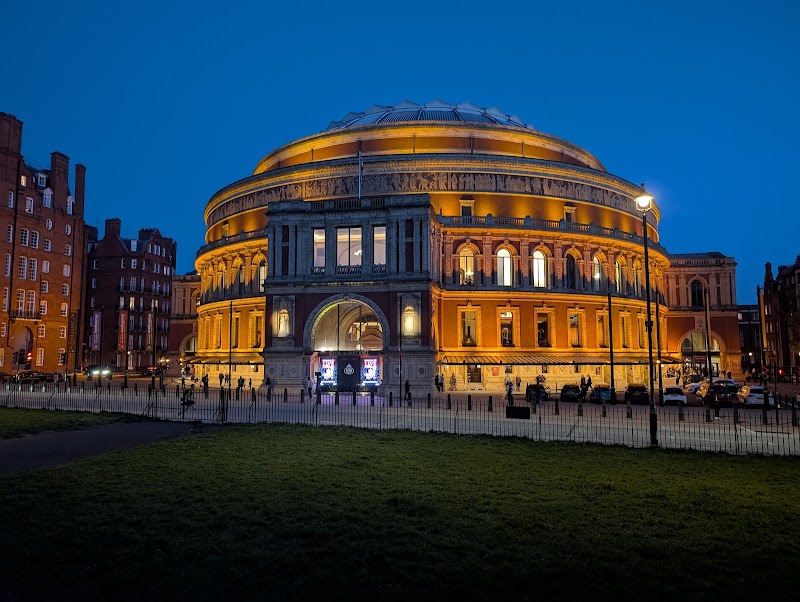
- Anyone with an hour between museums — the Gardens sit directly behind the great South Kensington museums and the Royal Albert Hall, making them the natural decompression stop of a museum day.
Getting there & practical
The Gardens straddle the boundary between the City of Westminster and the Royal Borough of Kensington and Chelsea, in central west London, with Hyde Park continuing east on the far side of the Serpentine bridge. Lancaster Gate and Queensway on the Central line put you closest to the Italian Gardens and the Peter Pan statue; Bayswater on the Circle and District lines and Notting Hill Gate on the Central, Circle and District lines serve the northern and western sides; High Street Kensington is the shortest walk to the palace; Knightsbridge and South Kensington on the Piccadilly line approach the Albert Memorial from the south. Useful buses include the 9, 10, 52, 70, 94 and 148. Entry is free, as it is to the Serpentine galleries and the Pavilion; Kensington Palace itself is a separate ticketed attraction run by Historic Royal Palaces. The Gardens open at six in the morning and close at dusk, so closing time shifts through the year and is much earlier in midwinter than in the neighbouring park. Ninety minutes covers the main monuments; half a day lets you add a gallery and the palace gardens.
When to visit
Spring brings the crocus and daffodil sweeps under the avenue trees, followed by the horse chestnut candles in May and the first outdoor tables at the Italian Gardens kiosk. Summer is the Gardens at their busiest and most sociable: the Serpentine Pavilion opens, deckchairs appear across the lawns, and the Round Pond fills with model boats and dabbling waterfowl in the long evenings. Autumn is arguably the best season for photographers — the limes and planes turn, the low sun rakes down the long avenues, and the crowds thin markedly once the Pavilion season ends. Winter is austere and beautiful: bare avenue geometry, mist over the Long Water, the Albert Memorial’s gilding catching what little sun there is, and an early dusk that clears the Gardens by mid-afternoon.
Good to know
The land began as part of Henry VIII’s Hyde Park hunting ground, seized from Westminster Abbey in 1536. Its separate life began in 1689, when William III, whose asthma suffered in riverside Whitehall, bought Nottingham House on the high, clean ground of Kensington village and had Christopher Wren enlarge it into Kensington Palace. Queen Anne extended the gardens with the help of the royal gardener Henry Wise, adding an orangery attributed to Nicholas Hawksmoor and John Vanbrugh. The decisive figure was Queen Caroline, wife of George II: from the 1720s she had roughly three hundred acres taken out of Hyde Park and remodelled by Charles Bridgeman and Wise into the avenues, basin and Long Water we walk today, and in 1728 the Gardens were formally separated from Hyde Park. The Serpentine and Long Water were created between 1726 and 1731 by damming the River Westbourne, an early example of a naturalistic lake in a formal English landscape. Kensington ceased to be the monarch’s principal residence after George II died in 1760, and the Gardens were opened to respectably dressed members of the public on Saturdays, then more widely from 1841. The nineteenth century filled them with monuments: the Speke Monument in 1866 to the explorer who identified the source of the Nile; the Albert Memorial, commissioned by Queen Victoria after her husband’s death in 1861, approved in 1863, opened in 1872, its gilded statue by John Henry Foley and Thomas Brock installed in 1875, listed Grade I in 1970 and re-gilded in a major restoration in the 1990s. The twentieth century added Frampton’s Peter Pan in 1912, Ivor Innes’s carvings on the Elfin Oak in the 1930s, Henry Moore’s Arch in 1980 and the Diana Memorial Playground in 2000. The whole landscape is registered Grade I on Historic England’s Register of Parks and Gardens.
Visitor tips
- Check the closing time before you plan a late walk — unlike Hyde Park next door, these Gardens shut at dusk, and in December that can mean closing in the middle of the afternoon.
- The Peter Pan statue is easy to miss because it stands slightly back from the water on the western side of the Long Water; walk the west bank rather than the east if it is on your list.
- The Serpentine Pavilion runs only from early summer to autumn, and both galleries close between exhibitions, so confirm what is open before making them the reason for the trip.
Questions & answers
Is Kensington Gardens the same thing as Hyde Park? No, though they adjoin and share a lake. They were one royal hunting ground until Queen Caroline had the western portion taken out and separated in 1728. The Gardens keep formal avenues and shorter opening hours; Hyde Park is more informal and stays open far later.
Does it cost anything to visit? The Gardens are free, and so are the Serpentine galleries and the summer Pavilion. Kensington Palace is a separate paid attraction with its own opening times, though the palace gardens around it can be walked without a ticket.
Where exactly is the Peter Pan statue? On the western bank of the Long Water, at the spot where Peter lands in The Little White Bird. J. M. Barrie had it erected overnight on 30 April 1912 without permission, then announced it in a newspaper notice the following morning so children would think the fairies had put it there.
Can children use the Diana Memorial Playground? Yes — it is designed for them, built around a large wooden pirate ship with sand, wigwams and water play. Adults are only admitted when accompanied by a child, and at peak times there may be a short queue for entry.
What is the Serpentine Pavilion and when can I see it? Each year since 2000 the Serpentine has commissioned an architect who has not previously built in England to design a temporary structure beside the gallery. It stands from early summer into autumn, is free to enter, and usually houses a café and an events programme.
Are dogs allowed? Yes, under control. Dogs must be kept away from the formal Italian Gardens beds and the children’s playground, and swimming in the Long Water is discouraged because of nesting waterfowl and water quality.
Is the park suitable for wheelchairs and pushchairs? Largely yes. The ground is flat and the main avenues are firm, though some are gravel; the Italian Gardens, Round Pond and Albert Memorial are all reachable on level routes, and accessible toilets are provided near the main refreshment points.
How much time should I set aside? An hour and a half is enough for the Round Pond, Italian Gardens, Peter Pan and the Albert Memorial at a steady pace. Add a gallery, the playground or Kensington Palace and you are comfortably into half a day.
Photos
Show 1 more photos
Visitor reviews
Reviews last updated: 2026-08-04 08:22:19
Data is refreshed monthly. Sources: londoname.com and editorial picks based on reviews.
A wonderful park where you can spend a lot of time and have a lovely rest
A lovely park, large. Two lakes, a flower garden, little fountains, cosy avenues; you can bring a blanket and relax with a picnic under the trees or in the middle of the meadow. Lovely for a walk with dogs. To visit the…
A good place to relax; the trees have been brought from various corners of the world, and you can feed the animals from your hand. The swans are a delight to the eye — they're not at all afraid to approach people.