

Park · London · ⭐ 9.3/10 · 27973 reviews · updated: 2026-08-04 08:22:19
Address: Green Park, London SW1A 1AA, United Kingdom
Green Park — the deliberately plain royal park that refuses to plant a flowerbed
Every other central London park competes with bedding schemes, boating lakes and bandstands. This one competes with nothing. Roughly forty acres of mature plane and lime trees rising out of open turf, no lake, no playground, almost no buildings — the smallest of the eight Royal Parks is also the most disciplined, a green wedge running between two palaces that turns solid yellow with naturalised daffodils each spring and then goes quietly back to being grass and shade for the rest of the year.
Highlights
- The spring daffodils — the park’s one great floral event, a naturalised carpet under the trees in March, and the only flowers you will ever see planted here in quantity.
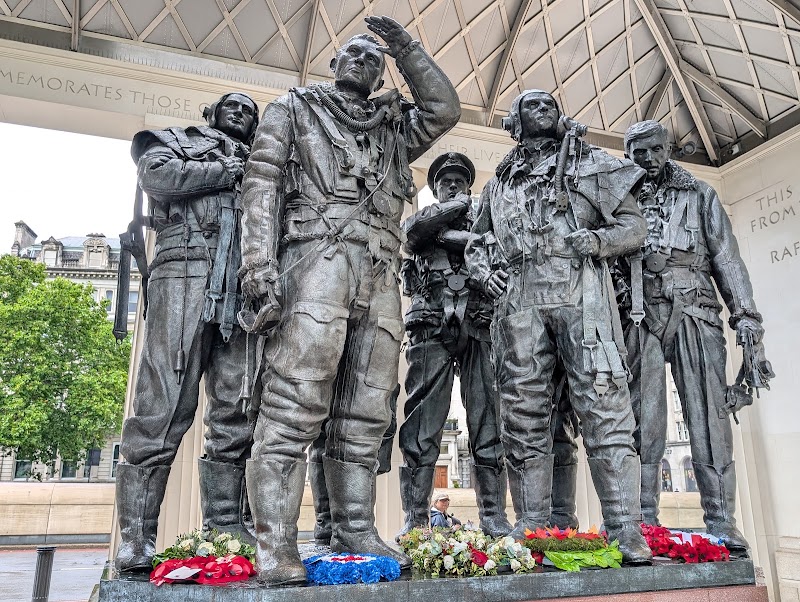
- The RAF Bomber Command Memorial — unveiled by Queen Elizabeth II on 28 June 2012, architect Liam O’Connor’s Portland stone colonnade shelters Philip Jackson’s bronze of a seven-man crew and commemorates 55,573 aircrew killed in the Second World War.
- The Canada Memorial — Pierre Granche’s sloping granite sculpture, unveiled by the Queen in 1994, is inlaid with bronze maple leaves and runs with a film of water; its central cleft is aligned towards Halifax, Nova Scotia.
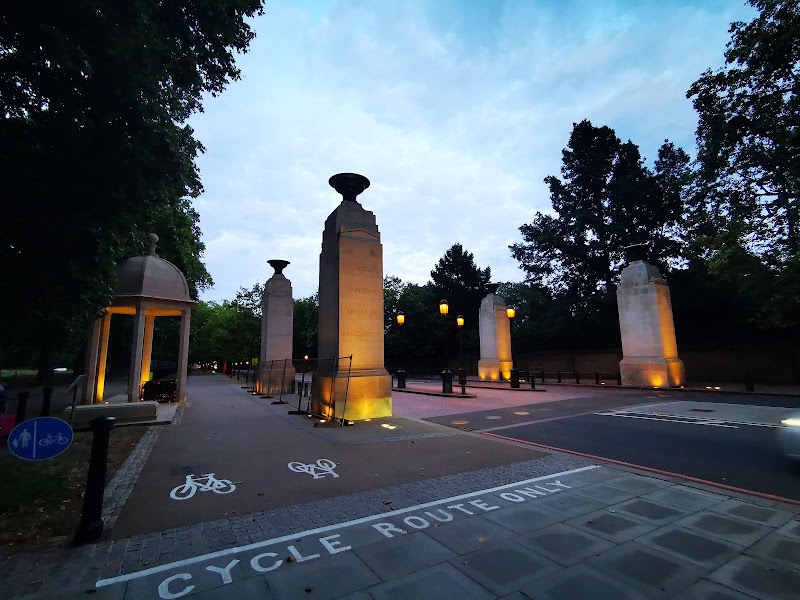
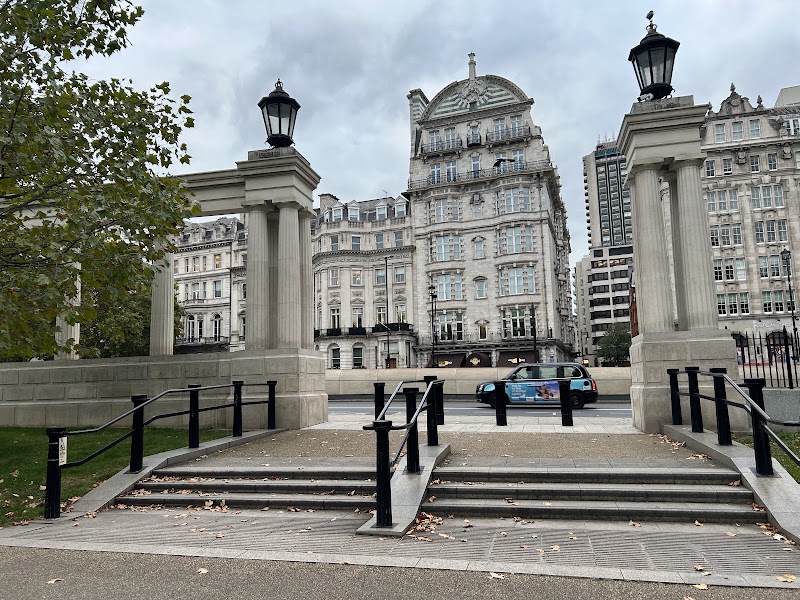
- The Memorial Gates — four Portland stone pillars by Liam O’Connor, unveiled in 2002, honouring the five million volunteers from the Indian subcontinent, Africa and the Caribbean who served with British forces in both world wars.
- Royal gun salutes — the King’s Troop Royal Horse Artillery ride into the park with First World War-era 13-pounder guns and fire a 41-round salute, the first round at noon, on the great royal anniversaries and state visits.
- The Queen’s Walk — the broad avenue laid out for Queen Caroline in the 1730s, which once led to a reservoir supplying St James’s Palace and still forms the park’s ceremonial eastern spine.
What you’ll find
The whole design idea is subtraction. There is no ornamental planting, no water feature and no visitor centre; what there is, is a high canopy of mature trees, wide turf, benches, deckchairs in summer and a handful of very serious monuments placed where they will be seen by people walking between Piccadilly and Buckingham Palace.
- Mature London planes and limes forming a continuous shaded canopy — the reason the park stays usable through a July heatwave.
- Open turf with no formal beds, and the Queen’s Meadow, designated in 2016 as a Coronation Meadow and sown with wildflowers to bring pollinators back.
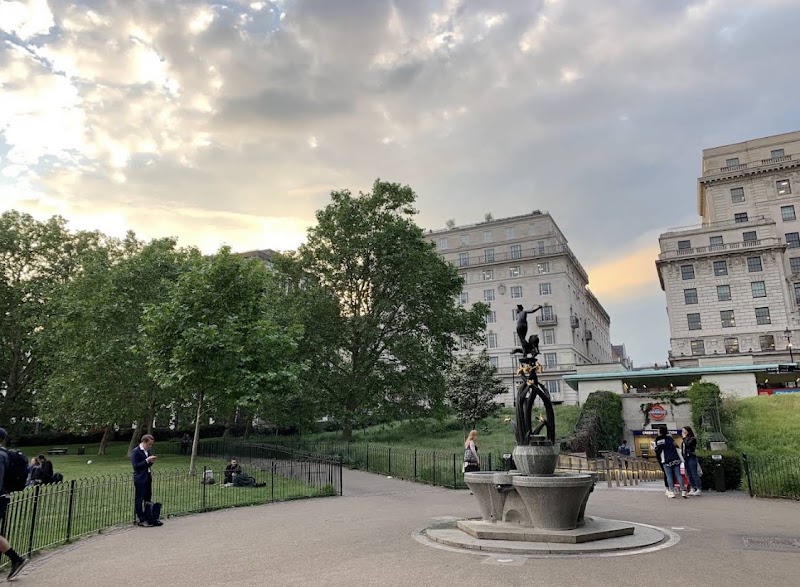
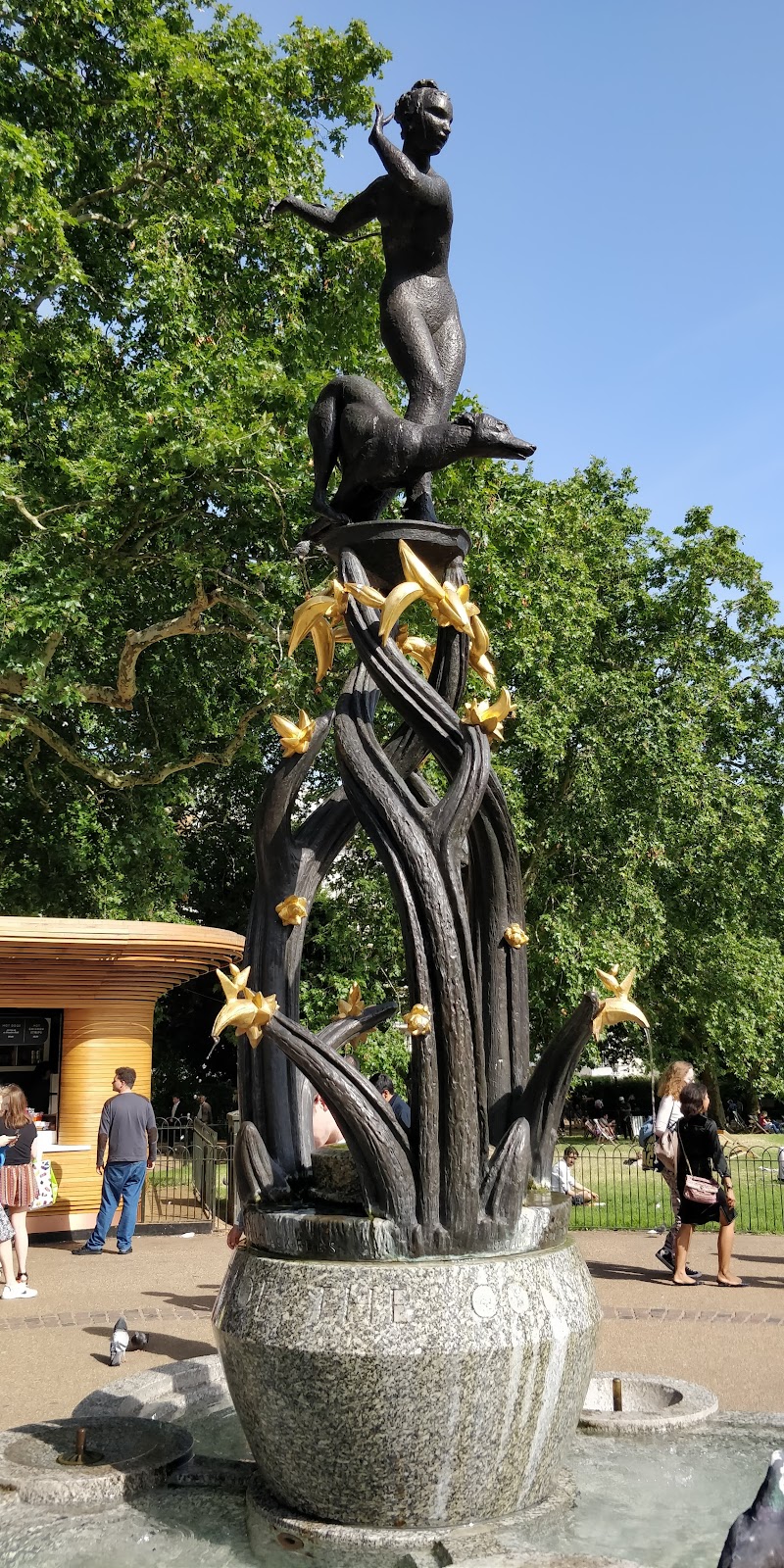
- Three major war memorials plus the Constance Fund fountain of 1954 by Estcourt J. Clack, known as Diana of the Treetops.
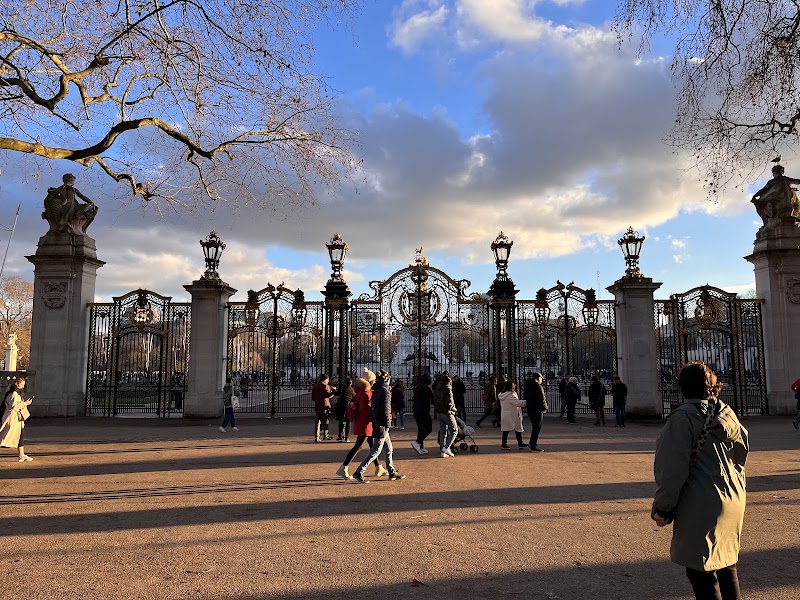
- Canada Gate, the gilded wrought-iron screen given by Canada and completed around 1908 as part of the Queen Victoria Memorial scheme at the Buckingham Palace end.
- Broad tarmac and gravel walks running diagonally across the park, part of the standard pedestrian route between the West End and the palace.
- Deckchairs for hire in the warmer months, seasonal refreshment kiosks, and no permanent café building at all.
Things to do — and who it’s for
- Visitors heading for Buckingham Palace — this is the pleasant way to arrive on foot, and the park empties out onto the palace forecourt in time for Changing the Guard.
- Office workers and shoppers — the tree canopy makes it central London’s most reliable lunchtime shade, a few minutes from Piccadilly and Mayfair.
- Anyone interested in remembrance — three of the capital’s most significant modern war memorials stand within a few minutes’ walk of one another here.
- Photographers in March — the daffodil carpet under bare plane trees, with the palace and the Victoria Memorial beyond, is one of the classic London spring pictures.
- Ceremony watchers — gun salute days bring horses, guns and a Royal Artillery band into the park, and are free to watch with no ticketing.
- People who want quiet — with no playground, no boats and no attractions, this is the least distracting green space in the centre of the city.
Getting there & practical
The park sits in Westminster, wedged between the West End and Buckingham Palace, with St James’s Park immediately to the south-east and Hyde Park a short walk to the west. Green Park station sits on its northern edge and is served by the Piccadilly, Victoria and Jubilee lines, which makes it one of the easiest green spaces in Britain to reach; Hyde Park Corner on the Piccadilly line serves the western corner, and Victoria — Underground and National Rail — is a short walk south. Buses 9, 14, 19, 22 and 38 run along the northern side. Entry is free and the pedestrian gates are open from five in the morning until midnight, considerably longer than most royal parks. There are no ticketed attractions inside, no visitor centre and no permanent café, though kiosks operate seasonally and deckchairs can be hired in summer. Thirty to forty minutes is enough to cross the park and see all three memorials; in March, allow longer.
When to visit
March is the one month the park does spectacle: naturalised daffodils flood the ground beneath still-bare trees, and for a few weeks this is among the best-photographed patches of grass in London. Late spring brings the plane and lime canopy into full leaf and the Queen’s Meadow into flower. Summer turns it into central London’s shade reserve — deckchairs out, salutes fired on the King’s official birthday, and enough leaf cover to sit out the hottest afternoons; it is also the busiest time, as palace visitors cross in a steady stream. Autumn is understated and lovely, the planes dropping late and the low sun coming through a thinning canopy. Winter reveals the park’s real structure: bare trunks, long sightlines to the palace, and memorials that read far more starkly without leaves around them.
Good to know
The ground was part of the Poulteney family’s holdings and known as Sandpit Field before it was surrendered to Charles II in 1668. He walled it, stocked it and called it Upper St James’s Park, apparently so that he could walk between St James’s and Hyde Park without leaving royal land — the origin of the name of the ceremonial road along its southern edge. It was renamed The Green Park in 1746. Queen Caroline had the Queen’s Walk laid out in the 1730s, running to the Queen’s Basin, a reservoir that supplied St James’s Palace; she also built a small library pavilion beside it. In April 1749 the park staged one of the most famous disasters in English musical history: a vast temporary pavilion was raised for a fireworks display marking the Peace of Aix-la-Chapelle, with music composed for the occasion by Handel — the Music for the Royal Fireworks — and the structure caught fire during the display. In 1814 the park hosted the Grand Jubilee, complete with a revolving Temple of Concord built inside a mock Gothic castle. It was a notorious duelling ground in the eighteenth century, including a celebrated 1730 encounter between William Pulteney and Lord Hervey, and later a launching site for balloon ascents. On 10 June 1840 Edward Oxford fired at Queen Victoria as she drove out along the park’s southern boundary. John Nash reworked the landscape in 1820 as part of the ceremonial approach to the palace. The absence of flowerbeds has a legend attached: Catherine of Braganza, discovering that Charles II had picked flowers here for another woman, is said to have ordered every bloom pulled up and none replanted. The lost River Tyburn still flows beneath the turf, and the park is on Historic England’s Register of Historic Parks and Gardens.
Visitor tips
- Come in March if you can — outside the daffodil weeks this is a park of trees and grass by design, and visitors expecting horticulture are routinely surprised.
- Check gun salute dates before a visit if you want to see the King’s Troop; they draw crowds, and the best vantage points along the firing line fill up well before the first round at noon.
- There is no permanent café and few toilets inside, so plan refreshments around the surrounding streets or the neighbouring parks rather than counting on facilities here.
Questions & answers
Why are there no flowers in Green Park? By long-standing design the park is kept as trees and turf, with no formal bedding at all. Only naturalised daffodils appear in spring, plus the wildflowers of the Queen’s Meadow. A persistent legend blames Catherine of Braganza, who is said to have had every flower removed after Charles II picked them for a mistress.
Is it free to enter, and when is it open? Entry is free and the pedestrian gates stay open from five in the morning until midnight — longer hours than most royal parks, which reflects the park’s role as a through-route.
Which memorials are here? Three major ones: the RAF Bomber Command Memorial of 2012, the Canada Memorial of 1994, and the Memorial Gates of 2002 honouring Commonwealth service personnel. There is also the Constance Fund fountain of 1954, known as Diana of the Treetops.
What is unusual about the Bomber Command Memorial’s construction? Its roof is made from aluminium recovered from a Royal Canadian Air Force Halifax bomber that came down over Belgium in May 1944 and was recovered in 1997 — a direct material link to the aircrew it commemorates.
When are the gun salutes fired? On major royal anniversaries — the monarch’s birthday, accession day, coronation day — and for some state visits. The King’s Troop Royal Horse Artillery fires 41 rounds here rather than the basic 21, because it is a Royal Park, with the first round normally at midday.
Is this the best way to walk to Buckingham Palace? For most visitors arriving by Underground, yes. Green Park station opens straight onto the park, and a walk of ten minutes or so through the trees brings you out at the palace and the Victoria Memorial.
Are there cafés, toilets or playgrounds? There is no permanent café building and no playground at all; refreshment kiosks operate seasonally and deckchairs can be hired in warm weather. Families wanting play facilities should head to the neighbouring royal parks instead.
How long does it take to walk across? Ten to fifteen minutes corner to corner. Half an hour to forty minutes is enough to take in all three memorials at a relaxed pace and still sit under the trees for a while.
Photos
Show 1 more photos
Visitor reviews
Reviews last updated: 2026-08-04 08:22:19
Data is refreshed monthly. Sources: londoname.com and editorial picks based on reviews.
A very lovely park for relaxing with the family
A good place to restore your spiritual strength
This park is next to Hyde Park, which is a plus. You can easily hire a bicycle and cycle around. Nearby there's also an extra green area with a lake.
If you're lucky, you might meet some "woodland friends": squirrels, d…
The park is beautiful, but there's no lighting at night, so it's dangerous there after dark